
Olexii
Shumskyi
Psychologist and psychotherapist ·
CBT · online
“What is important is not what people make of us
— Jean-Paul Sartre
but what we ourselves make of what they have made of us.”
Part I
What my work is about
I help people be present in their own lives. In life as it really is, not as it was supposed to go according to plan, or as it used to be.
And in reality, it holds very different things: pain and joy, grief and gaining something new, anger and tenderness. It would be nice to keep the pleasant parts and somehow get around the rest. But feelings don’t take well to sorting. People who keep pain at a distance for a long time often notice that joy has grown quieter too.
That’s why I’m not interested in how to get rid of part of life, but in how to choose within it. A person’s life has great value in itself. The circumstances in it can be anything at all, and people often don’t choose them. But you can choose what to make room for and what to keep your attention on.
Imagine a person in the middle of a forest. They’re alone there, without anyone or anything. They’re cold, hungry, scared, and hurting. No one ever taught them to live like this, and they don’t yet know how it’s done.
They can stop and simply let whatever is happening happen. They can act as if nothing has changed: as if the warm apartment and their loved ones were still all around, and the forest were some kind of misunderstanding. They can decide that they now have a new, harsh life and do only what it demands. Or they can try to look at everything as a whole.
Seeing things as a whole means throwing nothing out: not the tiredness, not the fear, not what used to be valuable, not the forest itself. When the person is tired, they rest. And what was valuable to them, they keep as a guide. Not to pretend the old life is still going on, but to figure out which of the things they valued can be set up here, in the forest, as far as conditions allow.
Say the most valuable thing in their old life was their connection with loved ones. Those loved ones aren’t nearby, but the person can spend part of the day with them in thoughts and memories. The rest can go to setting up a safe place to recover in and learning new ways to find food. None of this makes the forest go away. But a life of their own begins in it.
That is what I call presence: living in the circumstances as they are, and at the same time by your own choice.
Part II
What people come with
The first request people come to me with often sounds something like this: “I want someone to make me feel better.” It’s an honest request, and I take it seriously. What’s interesting about it is that the word “better” is still empty. The person already knows exactly how they don’t want things to be, but not yet how they do. Filling that word with meaning is part of the work too.
Along with this, there’s often a hope for a tool. The image of a road helps me here. At some point, a person set out down some road and is still walking it, and what they expect from therapy is a better way to travel: a bike instead of walking, a car instead of a bike. Sometimes that’s exactly what’s needed. But the same request can have three very different stories behind it.
In the first, the road is their own, the direction is clear, and they’ve just hit a hard stretch. Then a tool really does help, and we pick one without needless philosophizing. In the second, the direction is their own too, but the way they’re moving wears them out: they’re going where they want to go, but along the way they’re losing their energy, their health, or their relationships with loved ones. In the third, they’ve spent years walking a road they once chose for reasons they no longer remember, or one that was chosen for them. Then a better bike will only get them faster to a place they may not need to go at all.
Say someone comes in with anxiety, and under the anxiety is a fear of uncertainty. They ask me to teach them to handle the unknown better. It’s a reasonable request, and this really can be learned. But if the whole road is built on not setting off without a guarantee, the new skills can easily go into avoiding the unknown even more deftly. The vehicle got an upgrade; the route stayed the same. Sometimes that’s right, too. It’s just good to understand what exactly you’re choosing.
And sometimes the tools are right, and the road is right, but a question won’t go away. What am I doing all this for? What should even be in my life, and what shouldn’t? How do I know what to choose? It sounds abstract, but these questions are very practical: the answer decides what a person spends their days on.
Neither a hard road nor relief proves anything on its own. It can be hard on your own road and easy on someone else’s. So I don’t rush to conclusions. I ask what it’s for.
Part III
What presence is
Presence is easiest to explain through its opposite. I see three ways people can be absent from their own lives. From the outside, none of them looks like absence: it can be a very active, conscientious life.
The first is living from the outside. The person does a lot, but it’s others who tell them why, what for, how often, and for whom: family, work, the people around them, “that’s how it’s done.” Inside, they have no answers of their own to these questions, so the energy to move comes from outside too. As long as the prompts keep coming, everything seems to work.
The second is living only on the inside. The person knows what they want, how, and what for. But this knowledge doesn’t go beyond their thoughts and becomes neither a choice nor an action. The inner world is rich, but the life around them seems to exist apart from it.
The third is the quietest. The person won’t let a wish unfold even in their imagination, because at some point they decided: this isn’t allowed. Not “it won’t work out right now,” but precisely “not allowed,” even in thought.
Presence rests on three things at once: what’s happening inside, what’s around you, and the action that connects the two. The person notices what they want and what they don’t. They see the conditions, the possibilities, and the limitations. And they try to give what’s inside some form on the outside.
And here you almost never get the poles of “I can’t do anything” or “I can do anything.” What matters can take up a hundred percent of a life, or one percent, and that share can be chosen too.
Sometimes something can’t exist in reality right now. Then it can live inside: you can keep a love safe, nurture a wish, hold on to an aspiration. You may not have something today but still take steps that create the conditions for it. And sometimes something isn’t there and never will be. Then you first have to acknowledge that, then understand what was behind it, and make room for something else.
Here it helps to tell a value apart from the form it lives in. Say someone really loved ice cream, and now they can’t have it. The ice cream was the form. The value is the pleasure of food, and it has other forms. For the person in the forest, this is a very practical question: there’s no ice cream there, but there are berries.
So there’s a choice every time. You can let something live only on the inside, and that’s a good choice if it helps you live. Or you can decide that only on the inside isn’t enough. Then you’ll have to learn to live differently and build a new form.
One thing about this makes me glad: there’s more of value in life than fits into one life. No one can fit it all in. If one facet is out of reach right now, others remain, and from them you can choose the ones that can live in reality as it is.
Part IV
Why choosing is hard
It sounds simple: choose what to make room for. In practice, this is exactly where it hurts most. No one knows in advance what form a value will live in. The only way to find out is to try.
It’s a two-way process. A person sees what matters to them, chooses a form, and tries it. And they may discover that it’s the wrong form. Or that the value itself turned out to be borrowed, not their own. To find this out, you have to spend time and energy, give up other possibilities that so far exist only in your imagination, and take a risk.
That’s why grief inevitably has a place in this work. Grief over years spent on what wasn’t yours. Over efforts that didn’t bring what you expected. Over a form that seemed like the only possible one. Without this grief, it’s hard to choose again: it’s difficult to walk away from what you haven’t said goodbye to.
At the same time, every attempt gives you something. The more a person tries, the more precisely they calibrate their values compass. Even an unpleasant answer from reality makes something clearer.
What gets in the way of trying? Rarely just one thing. Skills, experience, tools, or opportunities may be missing. There may be no one nearby to offer support. Unpleasant consequences may be hard to bear, and then it’s completely natural to want to get around unpleasant feelings. And often, long ago, the person learned that making mistakes, asking, or wanting is unbearable and painful. They still protect themselves the way they learned to back then, even if now it gets in the way of living, choosing, and giving themselves permission.
Limitations deserve a word of their own. It’s easy to see them only as a loss, and then about all that’s left is to give up. But limitations also give focus. Even when there are few outside obstacles, you have to set your own limits, so you don’t spread yourself thin over everything at once and can have depth in at least something. And limitations always leave a fallback: if not this, then under these conditions, here’s what’s possible.
That’s why “just choose and do it” doesn’t work here. Choosing is hard for good reasons, and those reasons become part of what we work on too.
Part V
How a reaction becomes a loop
Some of these reasons show up clearly if you look closely at one habitual reaction. For this, I have my main method — cognitive behavioral therapy. It takes what usually blurs into a single “it hit me again” and breaks it down into steps.
Something happens, and the event takes on a certain meaning for the person. Sometimes that meaning sounds like a thought, and sometimes it hasn’t been put into words yet, but the body has already tensed and attention has narrowed. Feelings come up, and there’s an urge to do something right away: check, explain yourself, go quiet, leave. The action brings relief, quick and completely real. But along with it, the old path grows a little stronger, and next time it all repeats with more confidence.
- Situationsomething happens
- Meaningwhat it means to me
- Body and feelingstension, narrowed attention
- Urge to do somethingcheck, go quiet
- Actiondo the usual thing
- Quick reliefcompletely real
the old path grows stronger
CBT makes this loop visible
These reactions don’t come out of nowhere. Each one does its own job: it protects from danger, reduces uncertainty, guards against shame, keeps a relationship intact, brings back a sense of control. Once, silence may have saved a relationship, control may have given at least some safety, and the habit of not asking for anything may have protected against rejection. What the person is striving for is usually still important today. The problem is the way they go about it, which once helped but now takes more than it gives.
CBT makes this loop visible. Not to find the “wrong thought” and replace it with the “right” one, and not to prove to the person that their reaction makes no sense. We figure out what the mind saw in the situation, what it was protecting against, and what other response would become possible. Sometimes it’s enough to look more closely at what the event means. Sometimes the body first needs help getting out of a state in which everything unknown seems like a threat. Sometimes it’s worth noticing an action that brings relief but doesn’t let new experience in. And sometimes it’s about taking a small step toward something the person has been avoiding for a long time.
CBT has exercises, behavioral experiments, tasks between sessions. I use them where they really help, but I don’t fit a person into a ready-made model. The point of a model is to see the person better. The method is what I use; the therapy itself happens in the encounter.
And sooner or later, that same old way shows up in this encounter too. My question may feel like distrust, a pause like judgment, a suggested structure like a demand to show results. This doesn’t get in the way of therapy; often this is exactly where it comes alive. We can notice what happened between us, name the tension, and look for a way back to connection. That’s how a new experience comes about: you can disagree and stay in the relationship, you can make a mistake and not beat yourself up over it.
Part VI
How we work
The work starts with what the person came with, even if for now it’s only “I want things to get better.” What exactly “better” means for them, I don’t know, and I don’t pretend to know. We figure it out together: we get to know their life until it becomes clear what they really want.
The most useful question along the way is very simple: what for? What do I want to get out of it? What job is this meant to do in my life? Say someone wants to learn to say “no” to their boss. What for? To have more time for themselves — that’s one function. To be respected — another. To stop living under constant tension — a third. What we do next depends on the answer.
Once the function is clear, we look for ways to fulfill it. There are usually more of them than it seems at first. We weigh the benefits and the cost of each, the short-term and long-term consequences. Then the person chooses. They do, not me: I can share what I see, but the choice remains theirs. Next, we make a plan, and they try a manageable step. Then we look at what worked, what didn’t, and what new things we’ve learned. From this, the next choice is born.
- What for?what job it’s meant to do
- Waysmore than you’d think
- Weighbenefits, losses, consequences
- The person choosesthe choice remains theirs
- A manageable stepa plan and an attemptFrozen? We look for an easier step
- Reality’s answerwhat worked, what didn’t
from this — the next choice
There will definitely be fear along the way, and unpleasant sensations too. If the person freezes, we look for an easier step. We can first play the situation out in imagination. We can break the step into smaller ones and start with the easiest, and if even that’s too big, find an easier one still. We can practice right in the session. Sometimes skills are missing, for example, the ability to work with your own thoughts, and then we develop them. Group work can be useful too.
We discuss the consequences ahead of time: how things might go and what might be valuable even in the outcome the person fears. Until there’s an attempt, there are only assumptions about reality. An attempt brings an answer, and sooner or later, among the answers, something of their own turns up.
Sometimes, after an attempt that didn’t work, a thought comes up that it’s better not to try again. Then we look at that thought itself and at the expectation behind it. Almost everything in life is gained through attempts, and some of them don’t work out. So it’s interesting to figure out where the expectation that it should work the first time came from.
Part VII
What I do and what I don’t
First, I help the person stop. Not forever, but to see their life as a whole, and not only from inside the motion they’re in: what they want and don’t want, what they can do and can’t do yet, what there’s enough of and what’s lacking. Then we decide together what to focus on first, and what that focus is for.
Stopping isn’t always easy. It brings into view what the motion helped them turn away from: pain, loss, shame, anger, uncertainty, the lack of a ready-made answer. Here my work is to be there. I support them, share in what they’re going through, and reflect back what I see. We look at their question from different sides, and sometimes the most interesting angle turns out to be new to me too.
This is how a person gradually learns to be with themselves: to notice themselves, to meet themselves, and not run from what they see. Along with this comes independence. Over time, they do it without me: they stop, see, explore, and choose — in small steps, every day, through joys and losses.
There are a few things I don’t do, on principle. I don’t choose for the person, I don’t force them, and I don’t do for them what is theirs to do. I don’t promise that the issue will definitely be resolved. I don’t make diagnoses, I don’t impose my worldview, and I don’t talk about my personal life. I don’t confirm who’s right and who isn’t, and I don’t read other people’s messages. I don’t clear feelings away just because they’re unpleasant. And, of course, I don’t act unethically or insult anyone.
When a person asks for a ready-made answer, I don’t brush it off. I’m curious why it matters to them. I explain what good and what harm one path or another can bring, or we think it through together: what they’ll gain, what they’ll lose, whether there’s a more helpful way to take care of what they need right now. The decision remains theirs, and so does the uncertainty. They just don’t have to deal with both alone.
And one more thing: I know the limits of my competence. If it becomes clear that the person needs a different specialist or additional help, I’ll say so directly.
Part VIII
When therapy has worked
At the start, you often hear “I want someone to make me feel better.” If the work has gone well, at the end you hear something else: “I can.” And spelled out: “I can live the life I choose for myself.”
This doesn’t mean there will be no more pain, fear, or mistakes in life. There will be. Nor does it mean being alone: loved ones, support, and, if needed, a therapist don’t go anywhere. It’s about authorship. The person knows how to stop, see what’s happening, hear themselves, meet reality, choose a form, take a step, live through the answer, rethink, and choose again.
In other words, they do on their own what we once did together.
What I work with
Most often: anxiety, depressive states and low mood, self-worth and how you relate to yourself, losing touch with your own values and goals, going through loss.
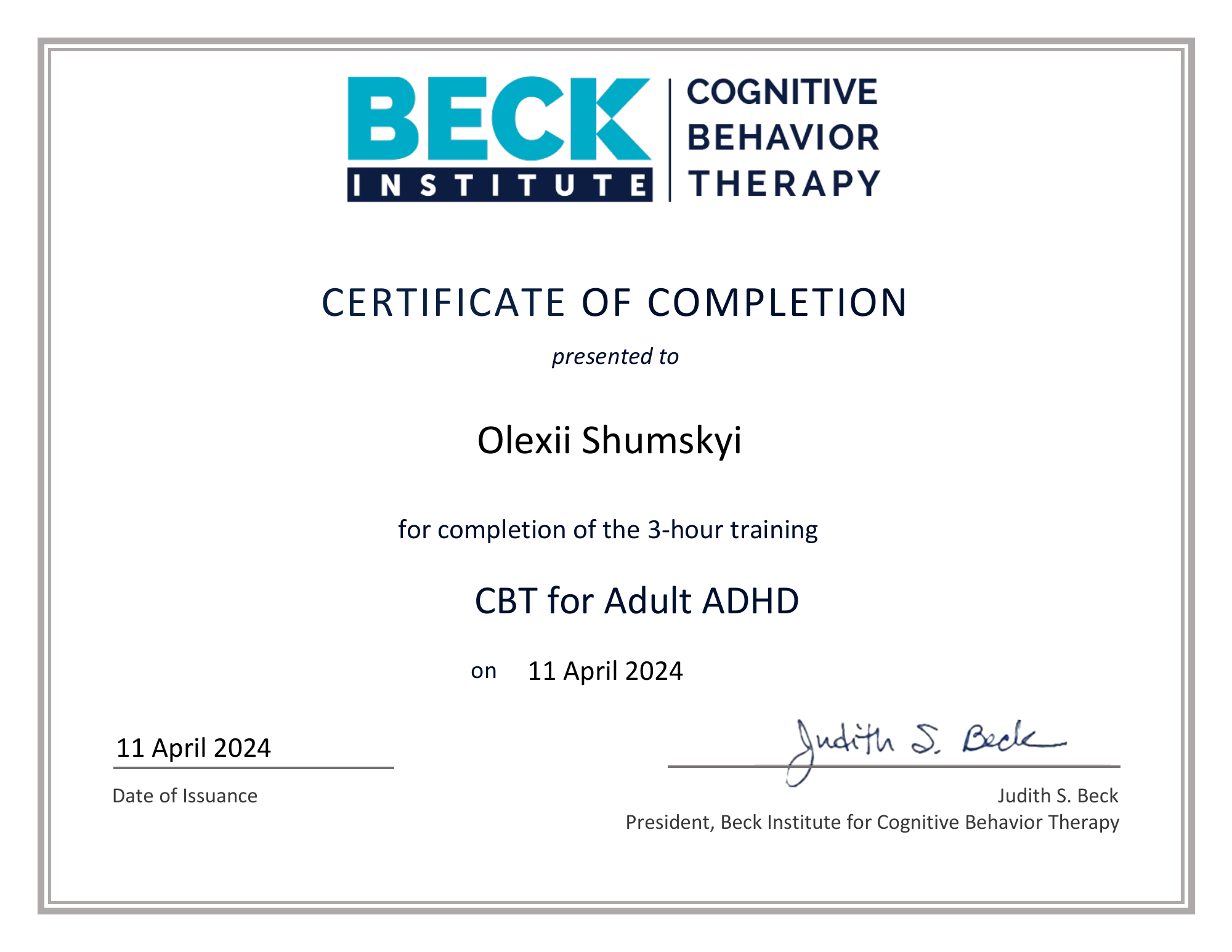
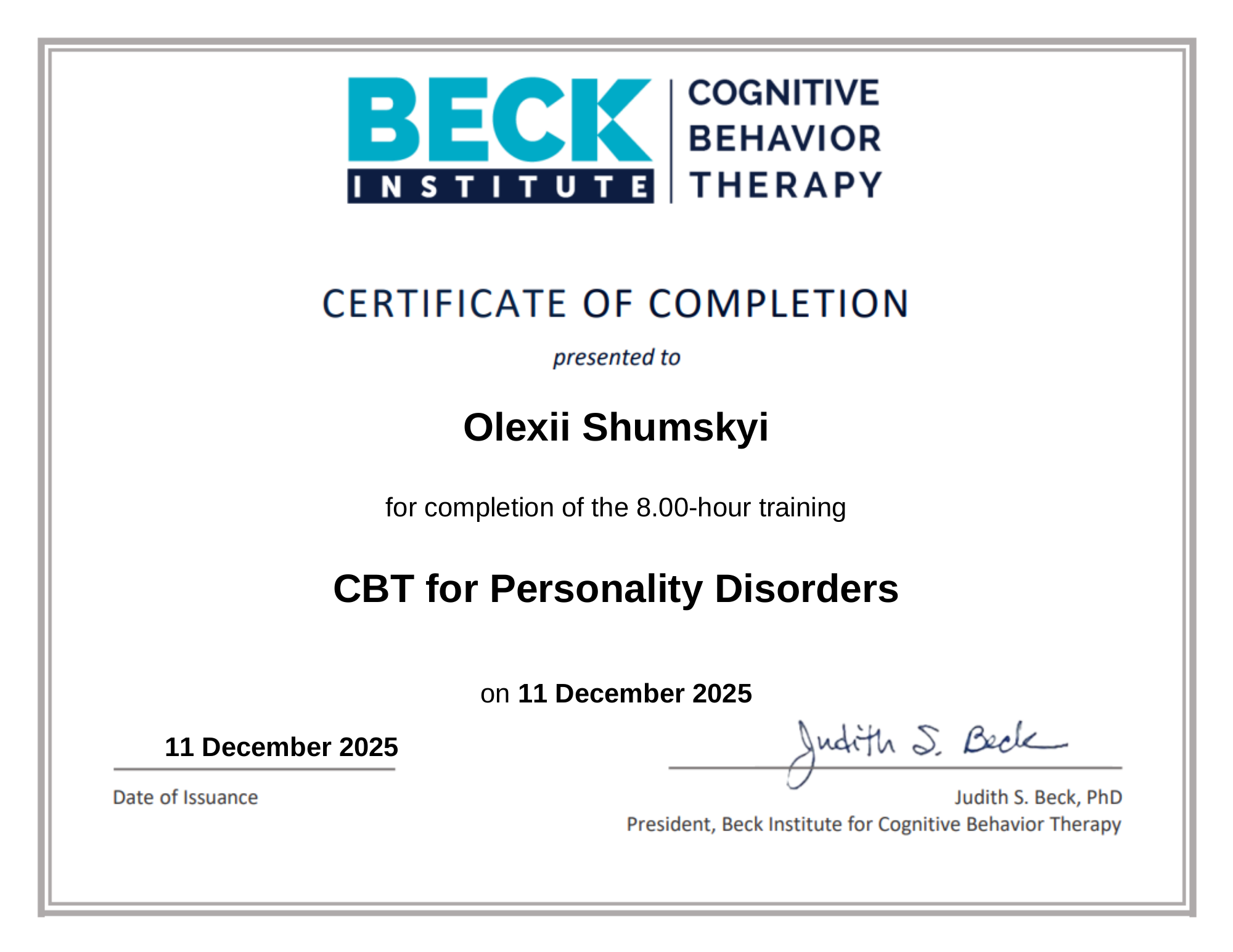
Deepening my competence in: personality disorders, romantic relationships, ADHD, self-regulation and discipline, sexuality and sexual behavior.
I don’t work with children and teenagers, with couples in joint sessions, with eating disorders, diagnosed autism spectrum and schizophrenia spectrum disorders, antisocial personality disorder, rehabilitation after physical injuries, or with addictions to psychoactive substances, alcohol, nicotine, or sexual behavior.
Education and certificates
I’ve worked as a psychologist since 2017 and practiced psychotherapy since 2019. I worked in schools and at a psychology center, and ran group classes and workshops.
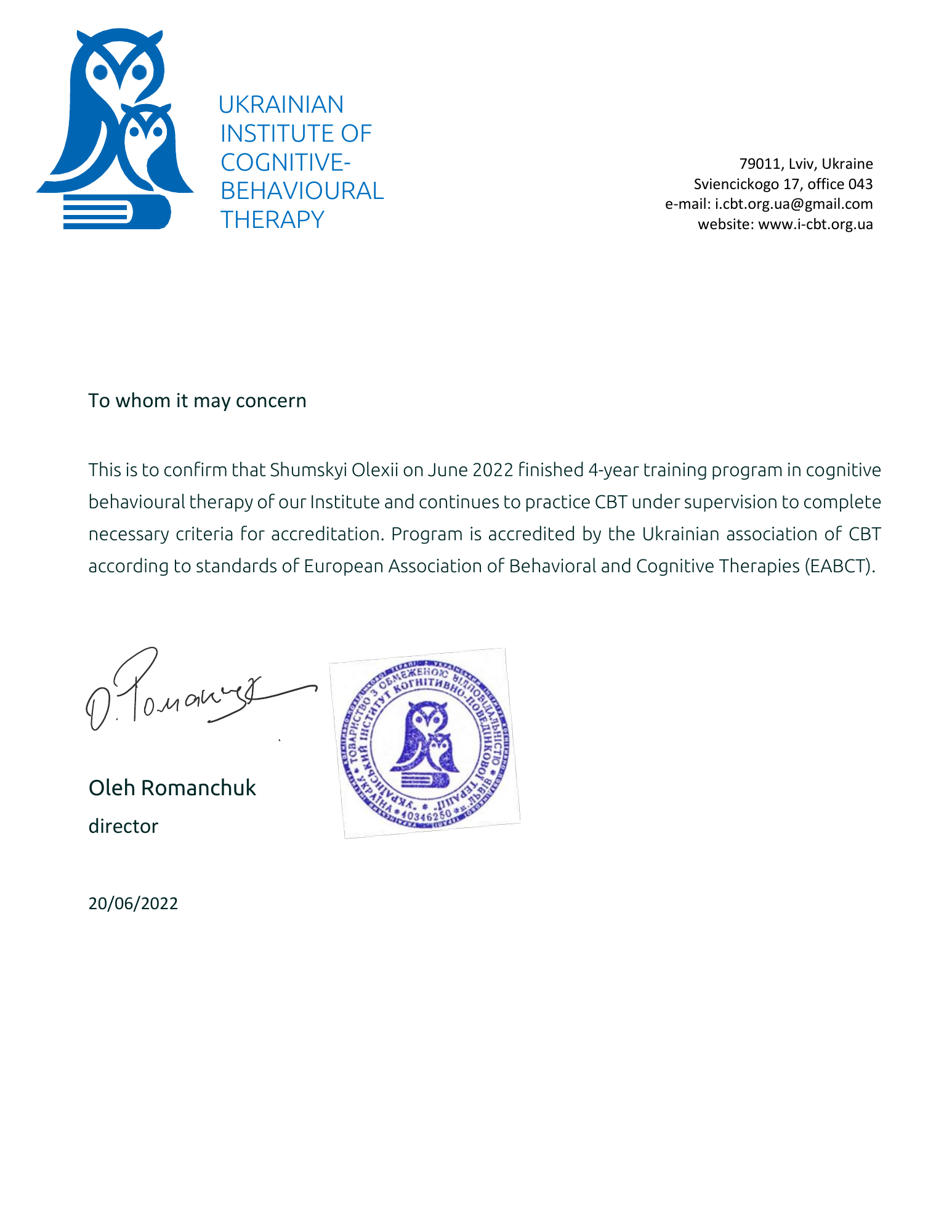
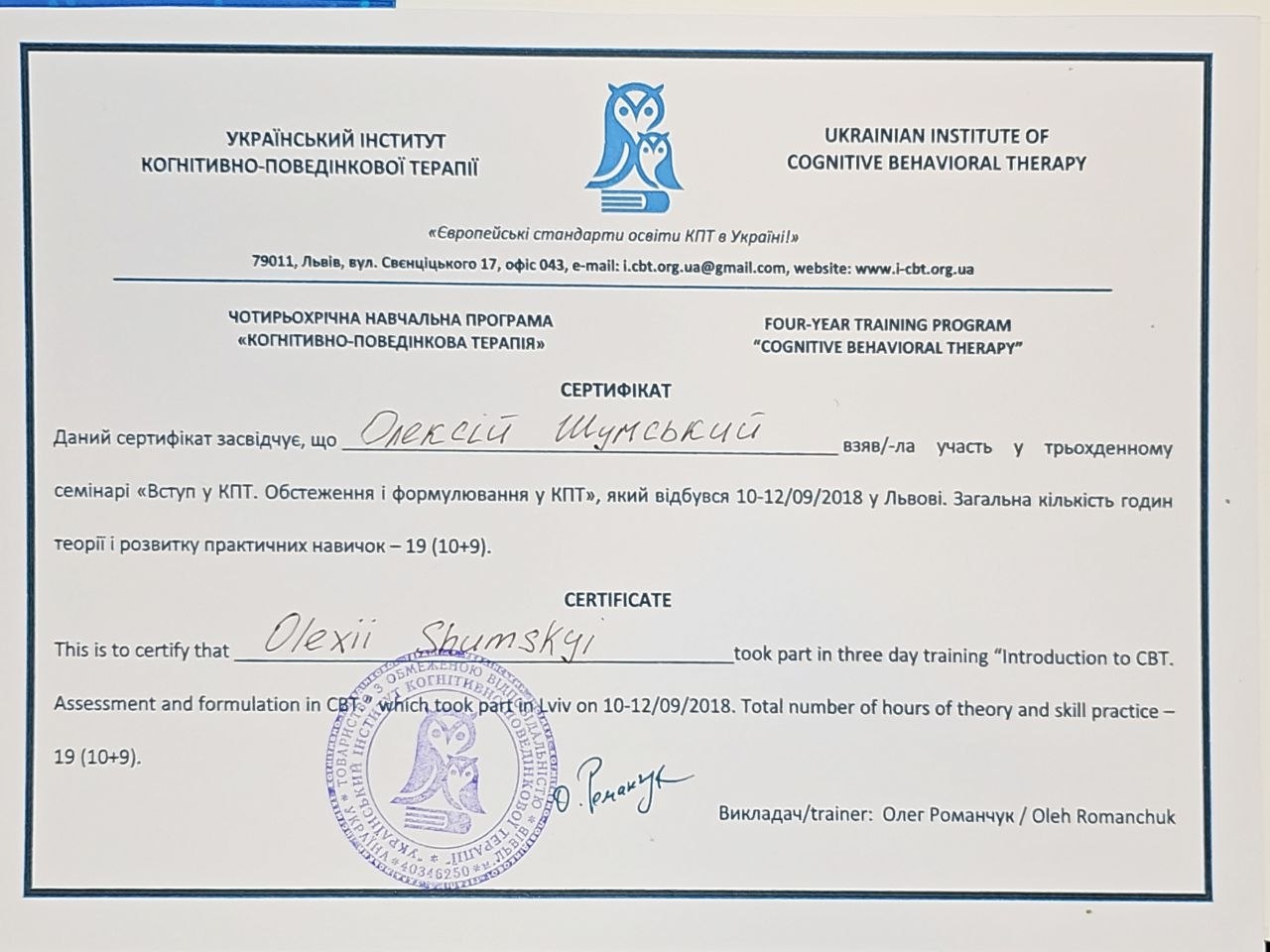
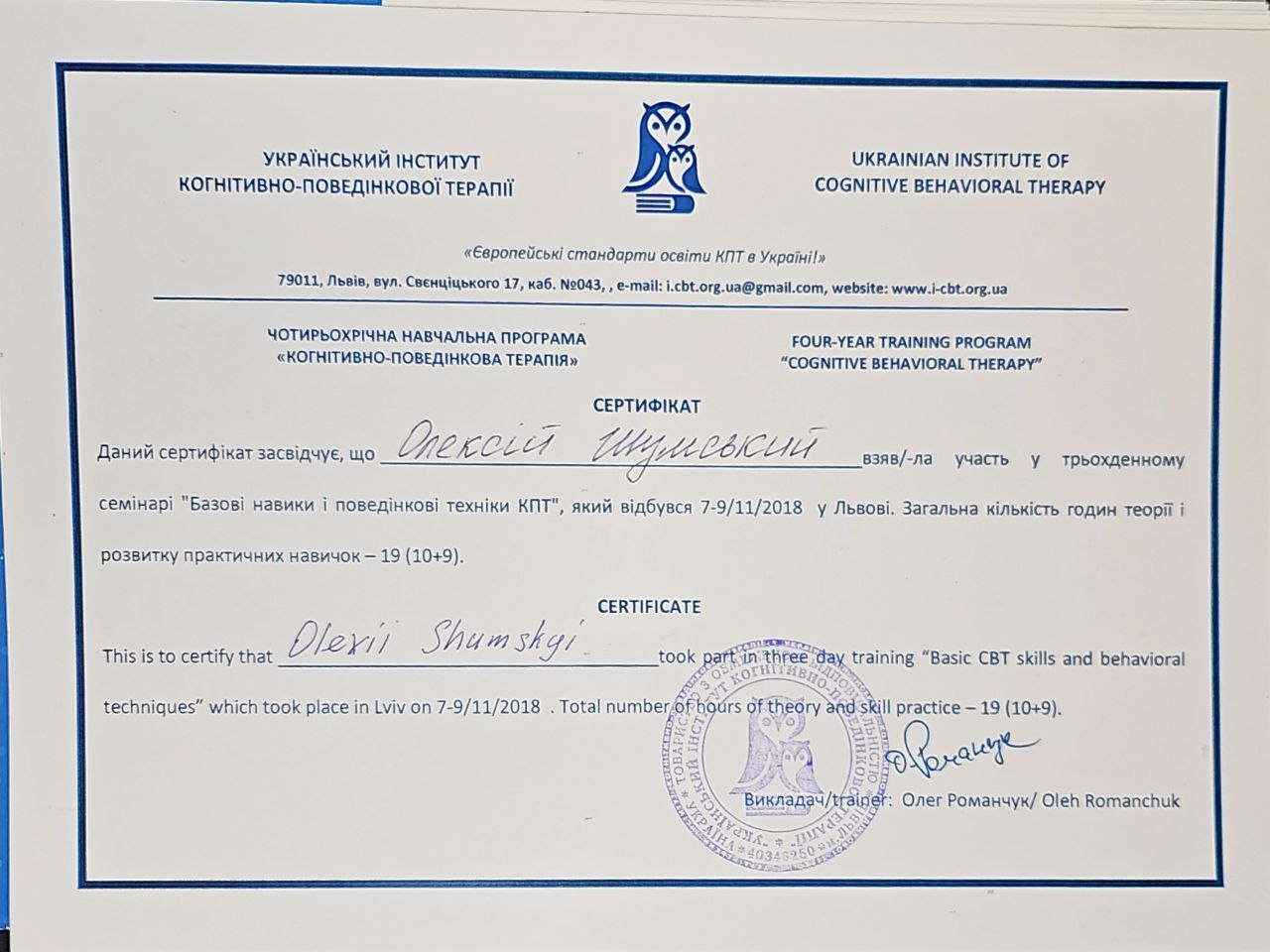
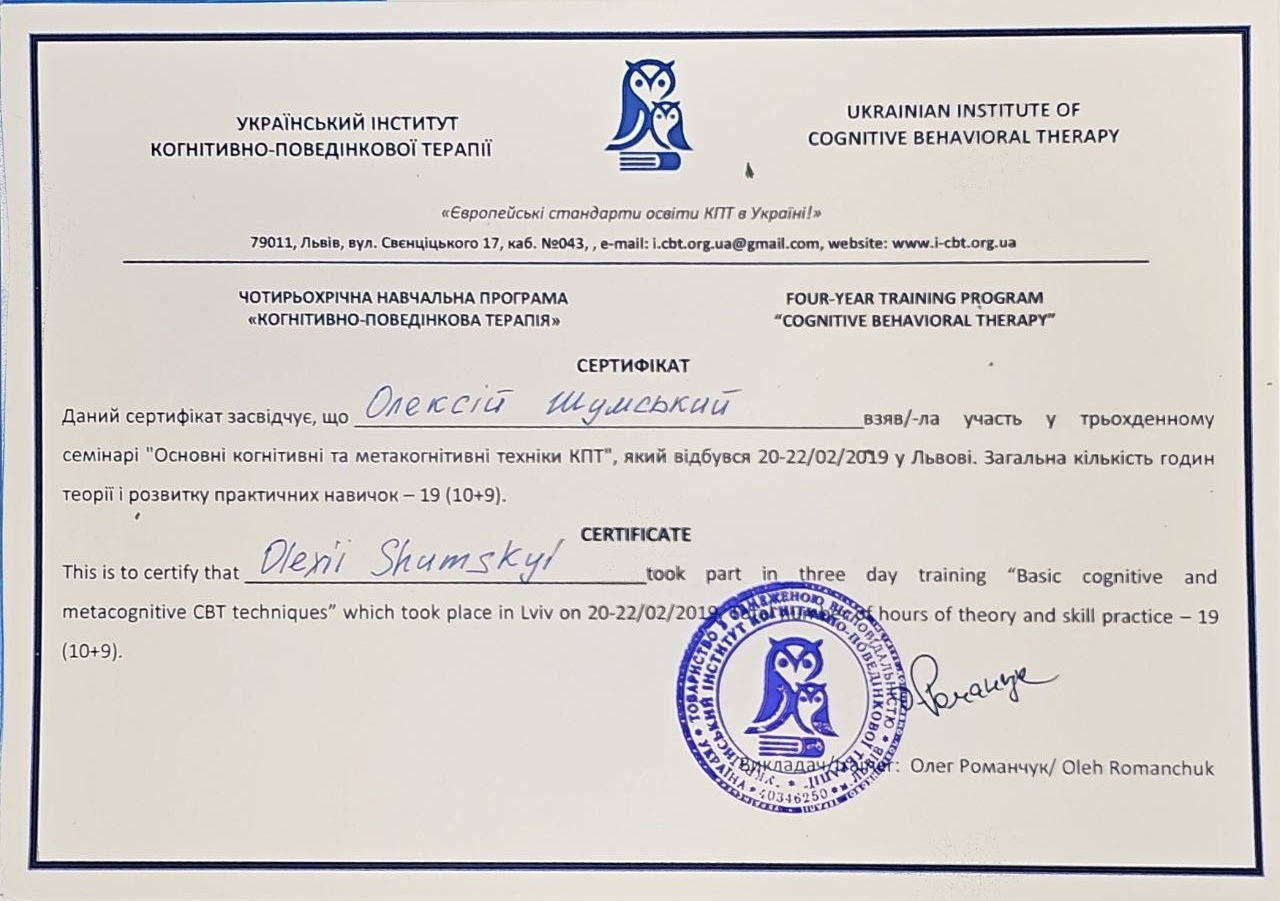
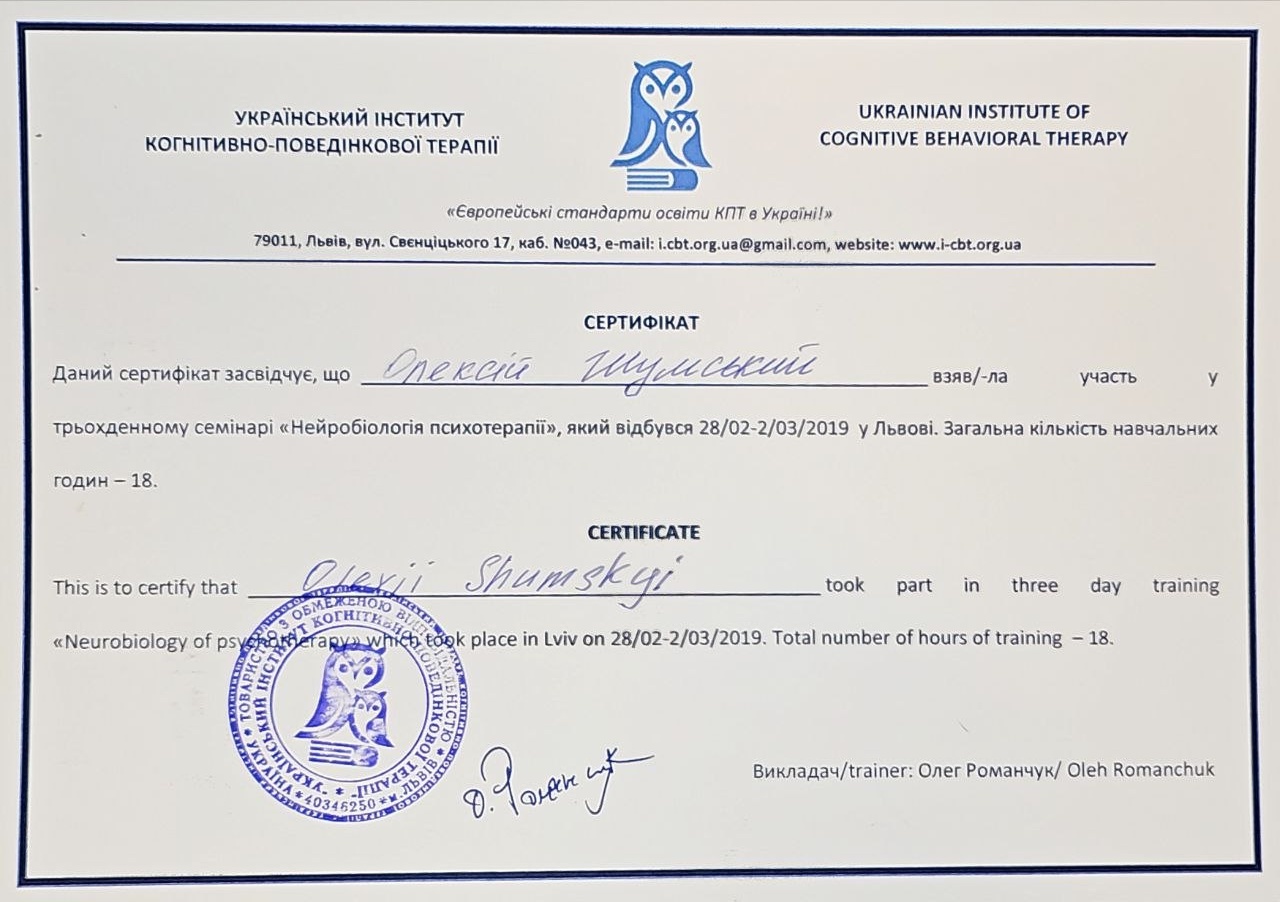
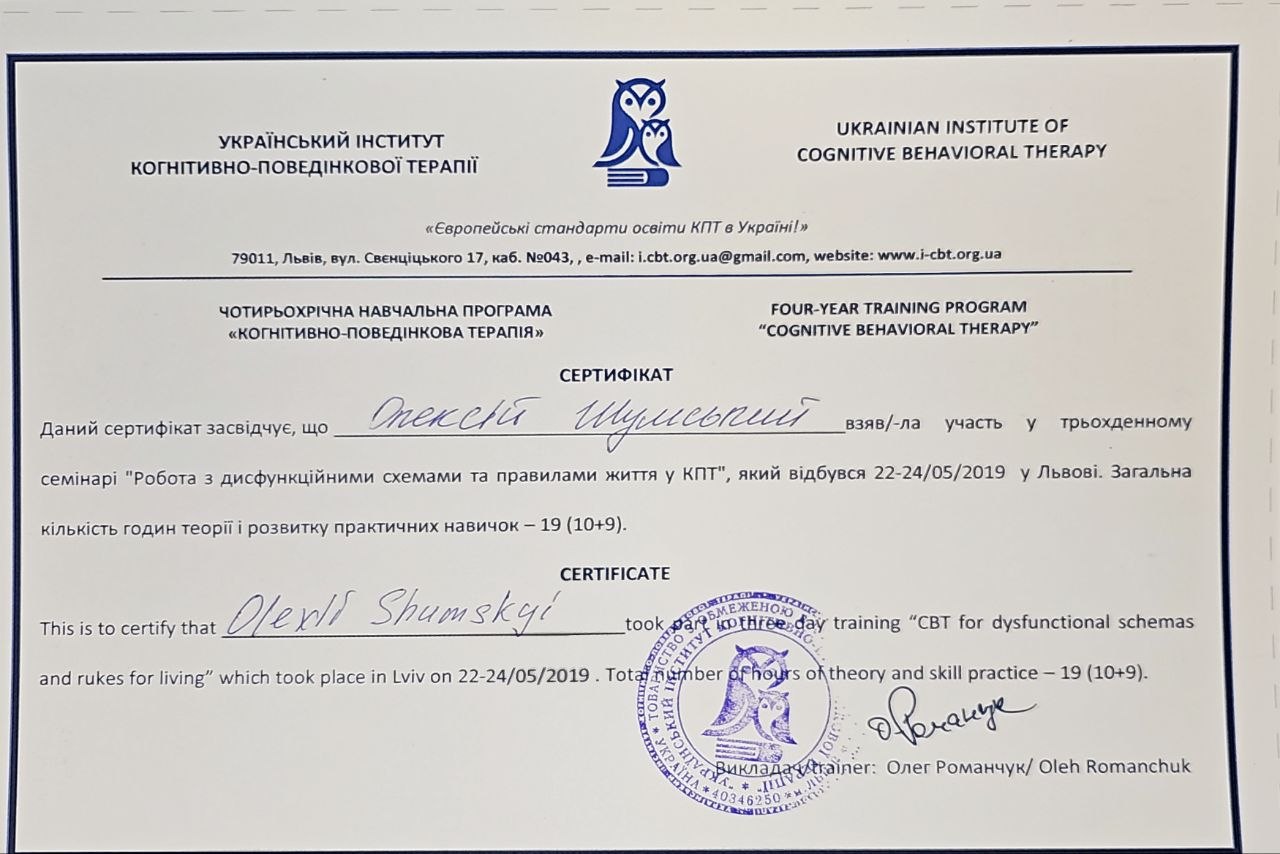
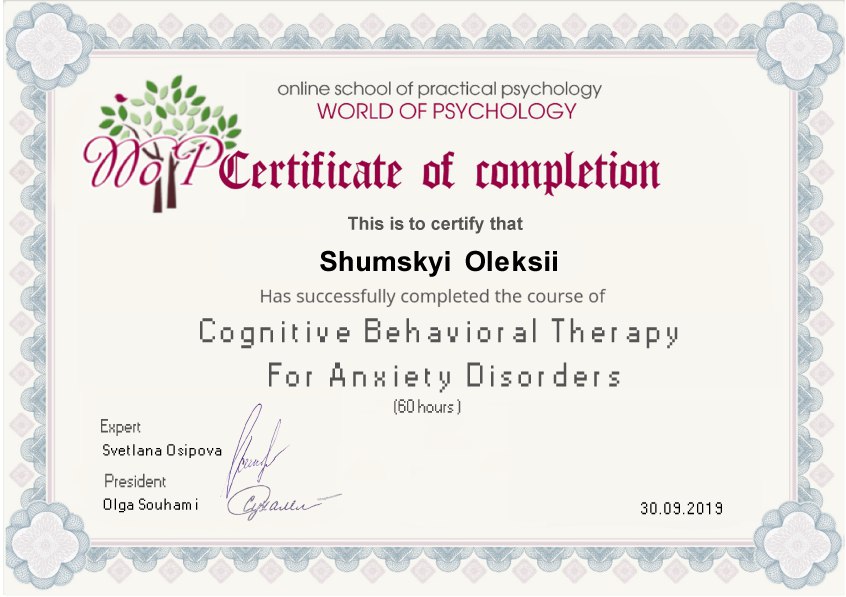
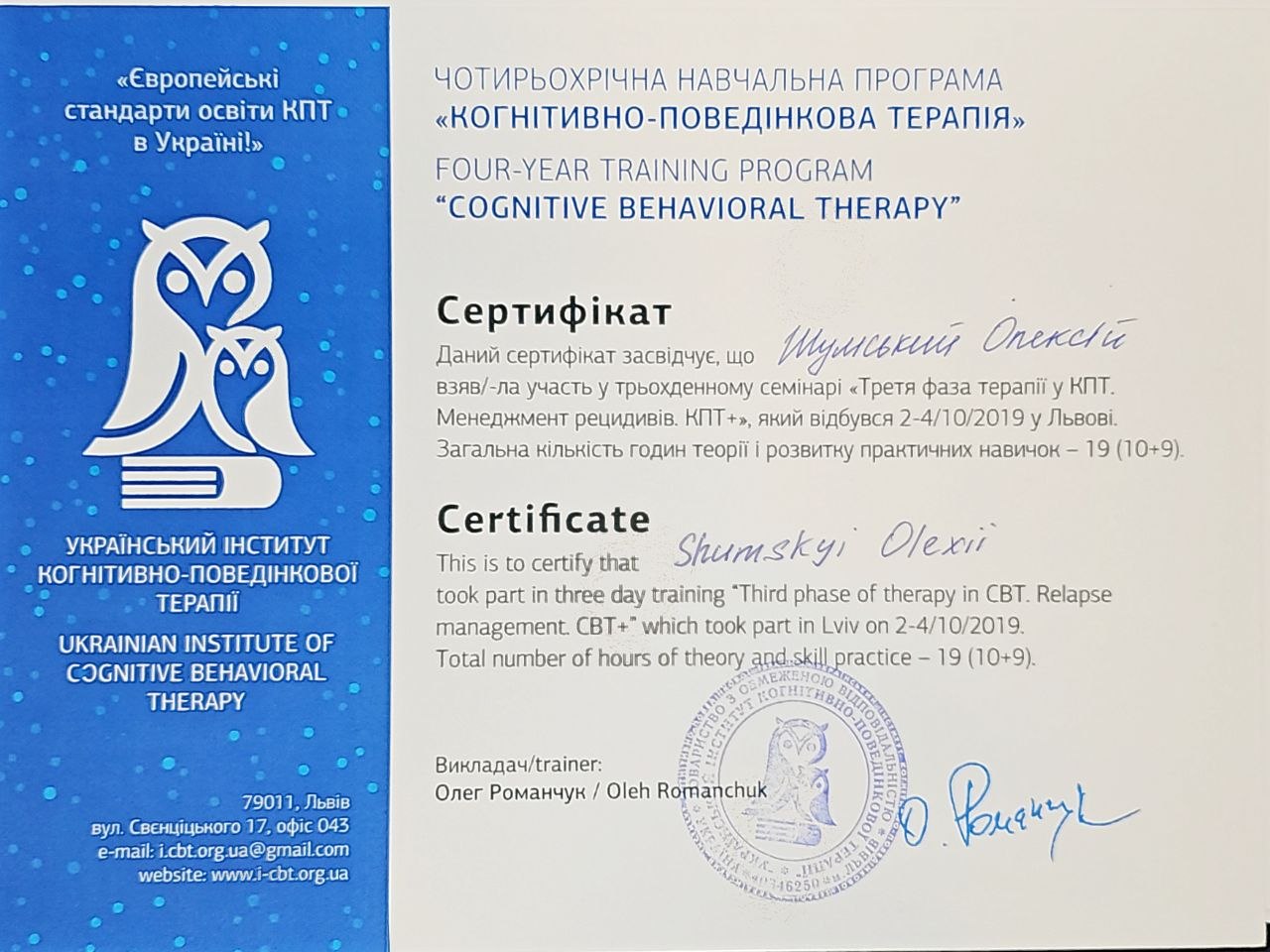
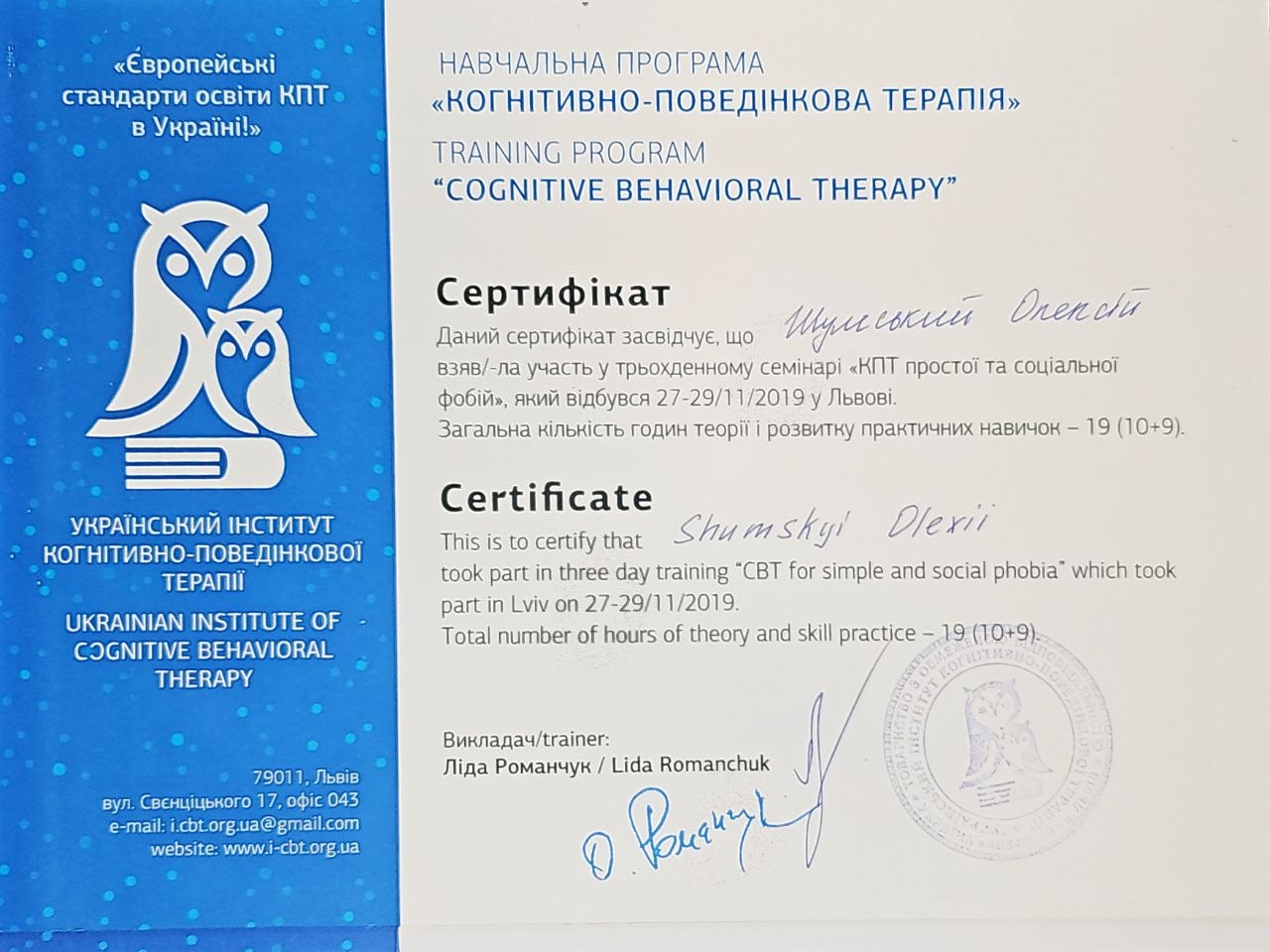
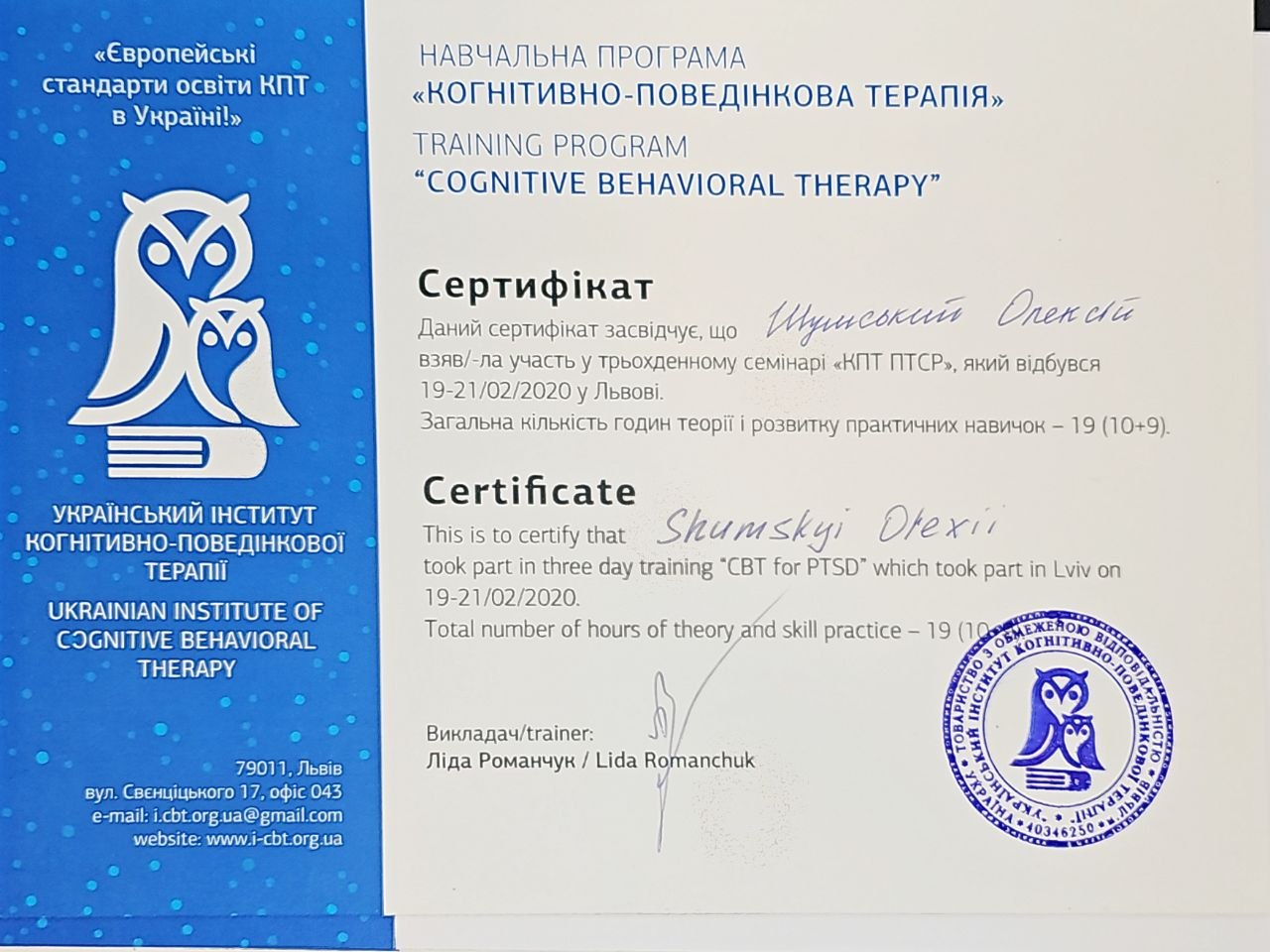
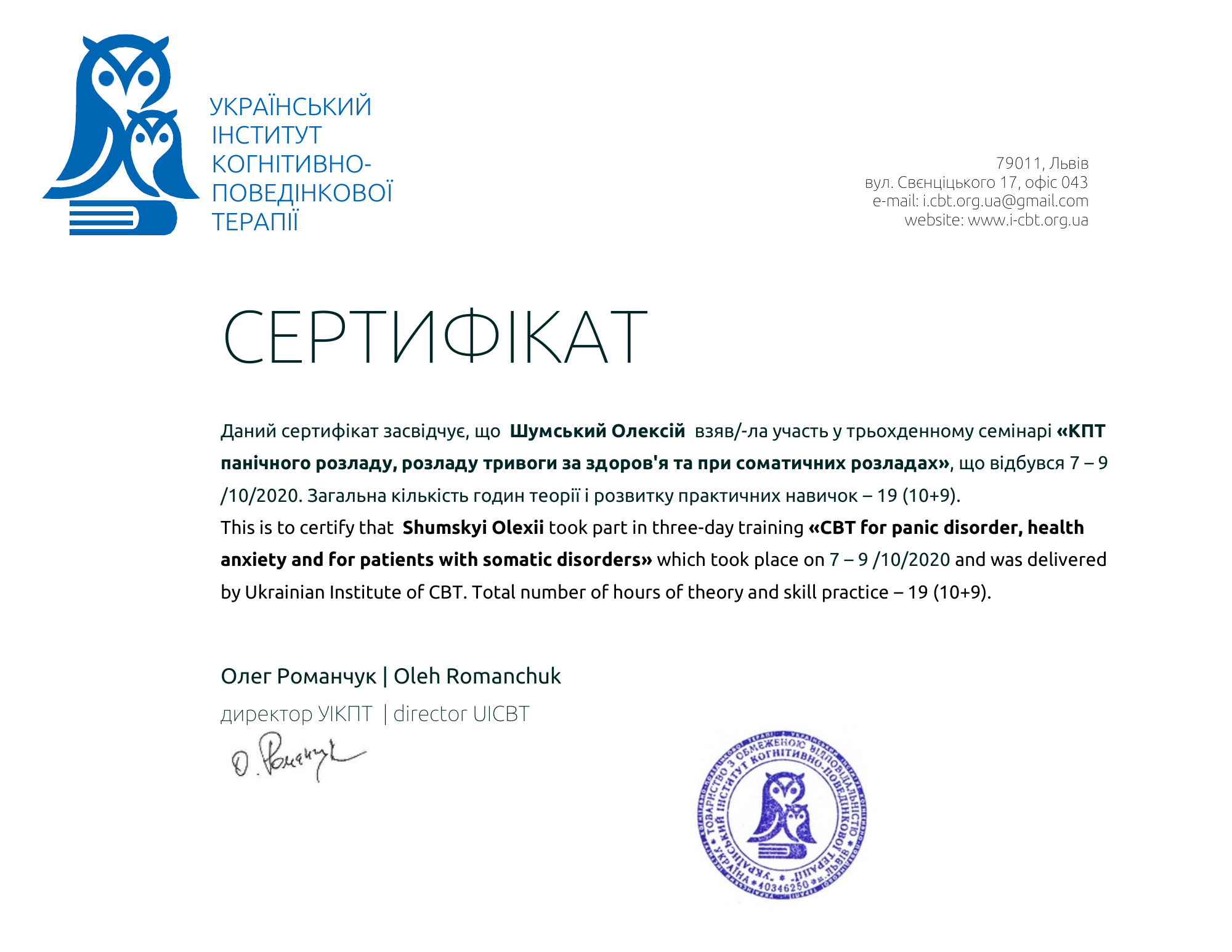
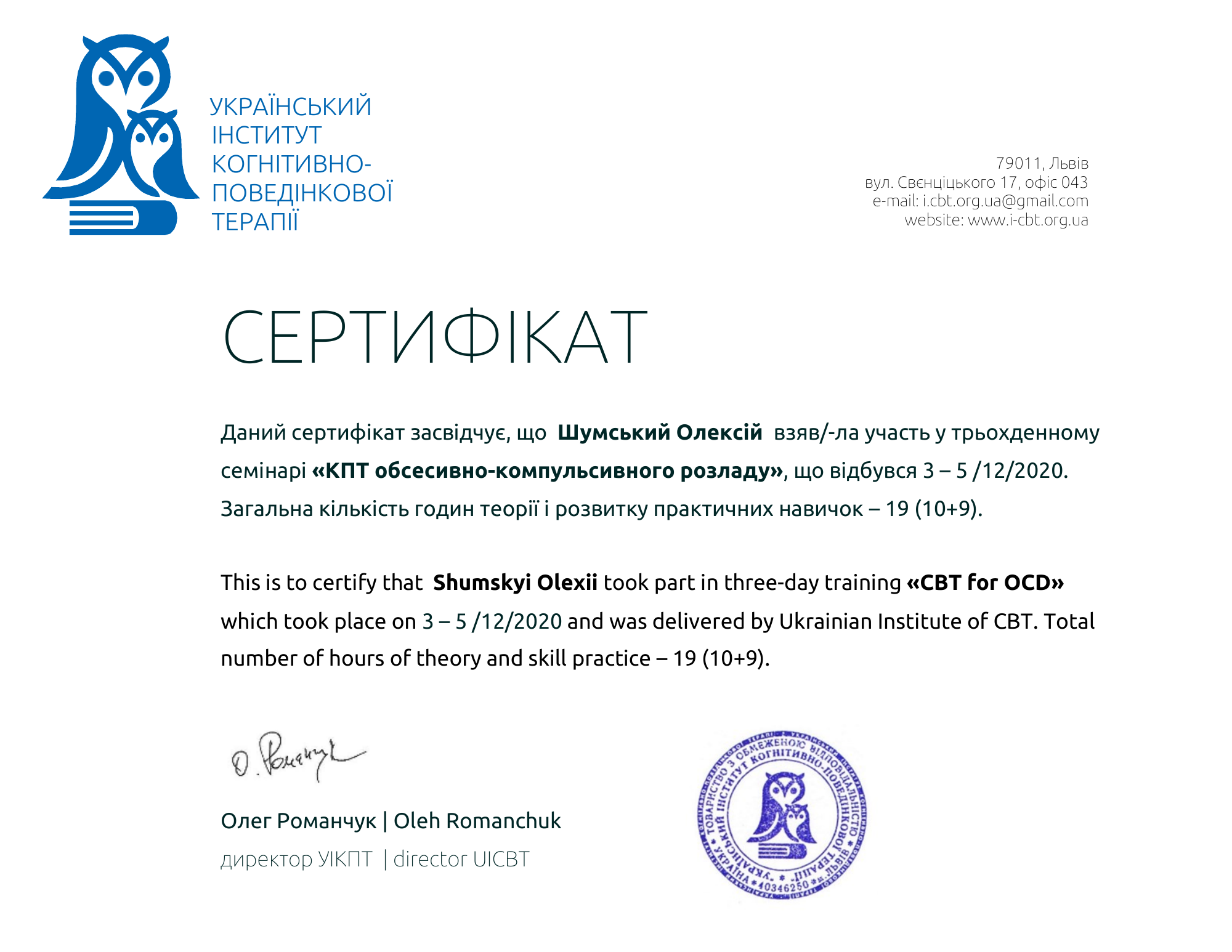
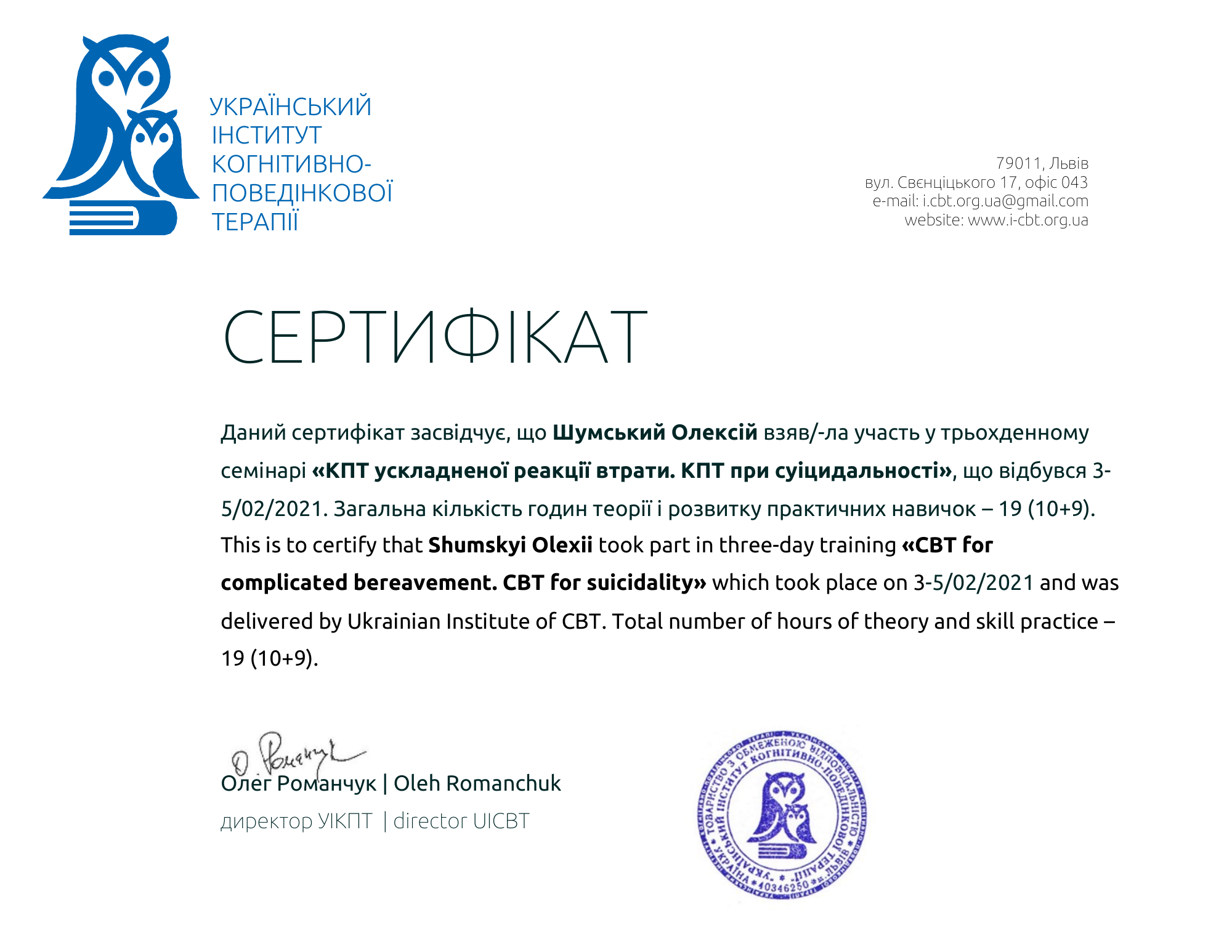
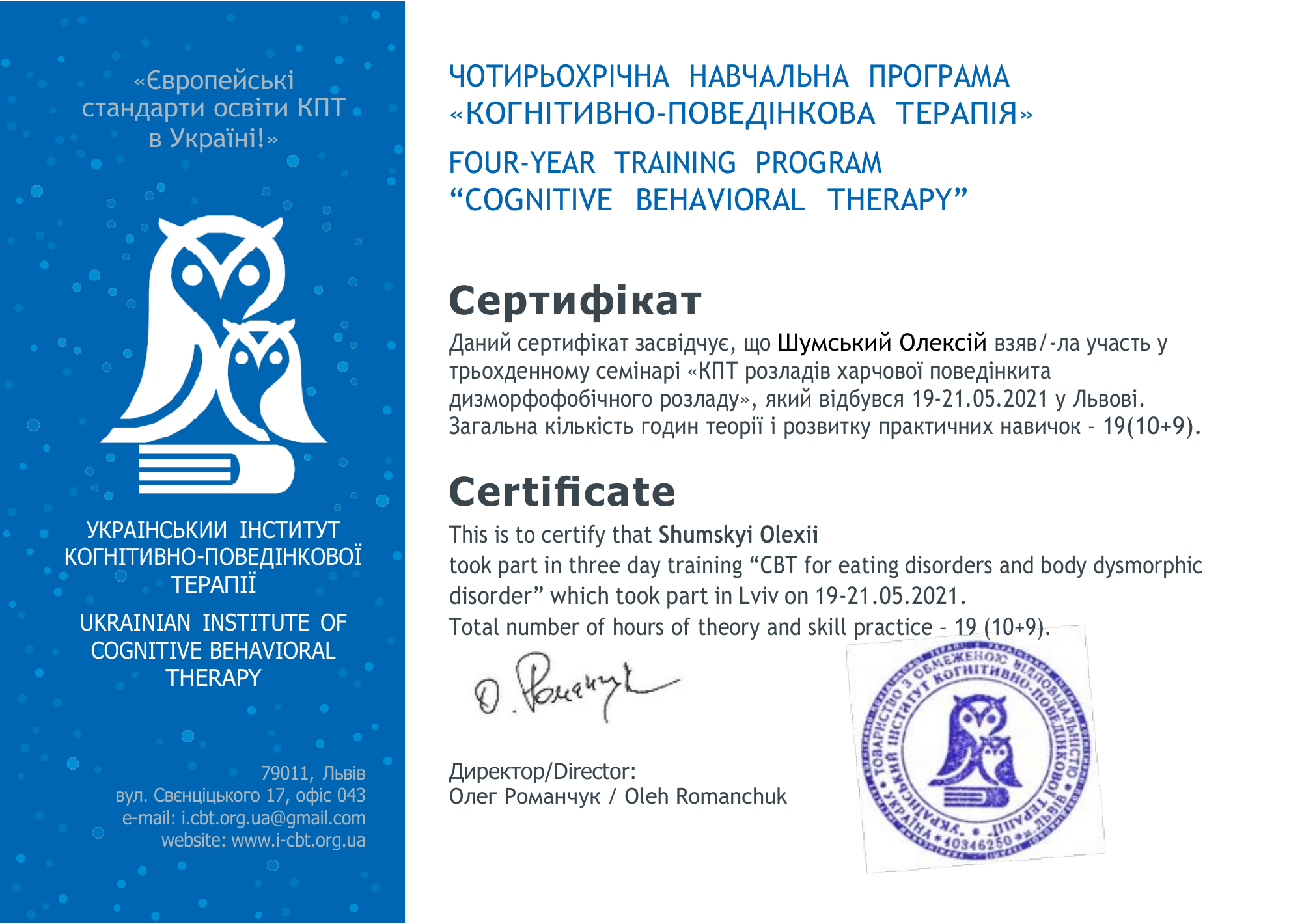
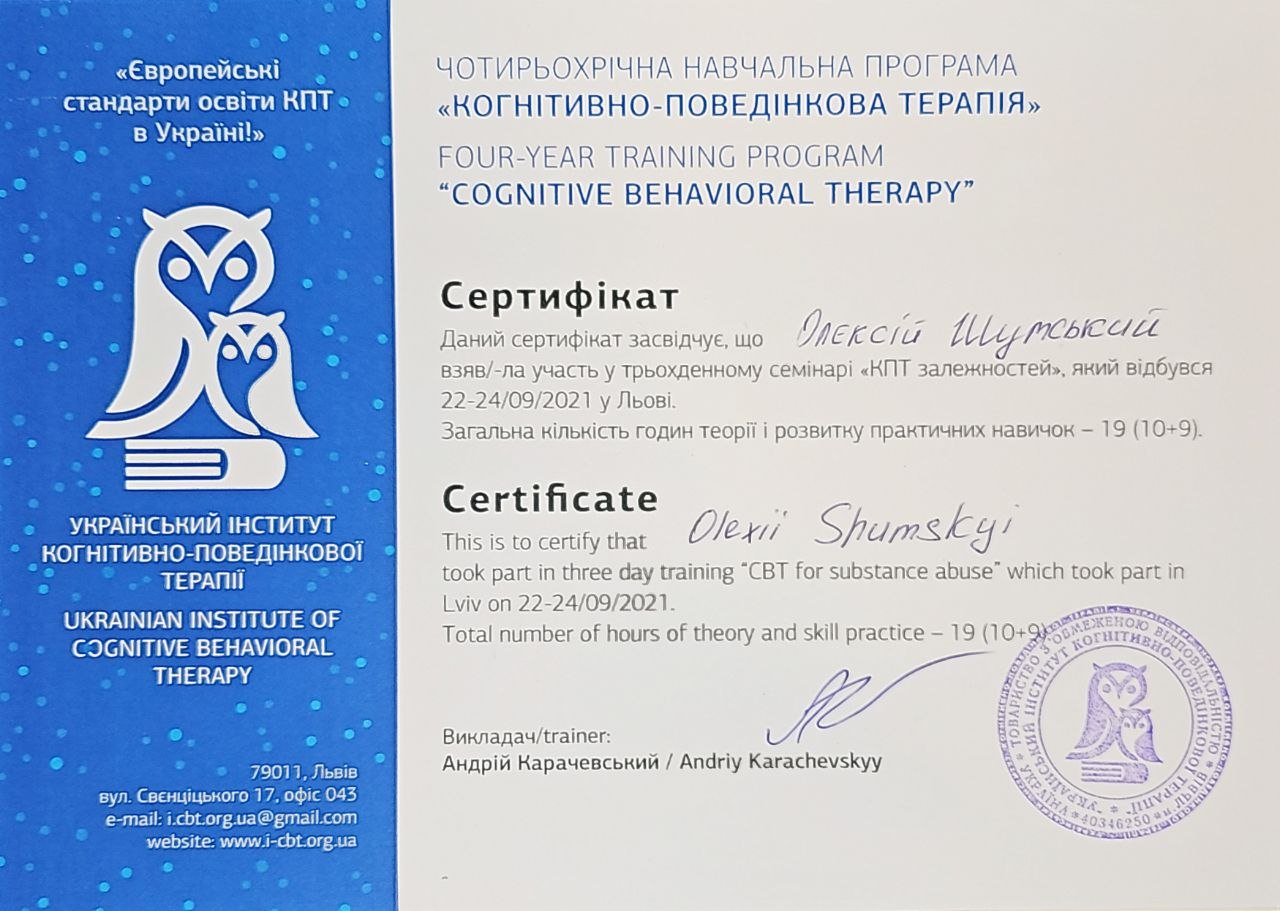
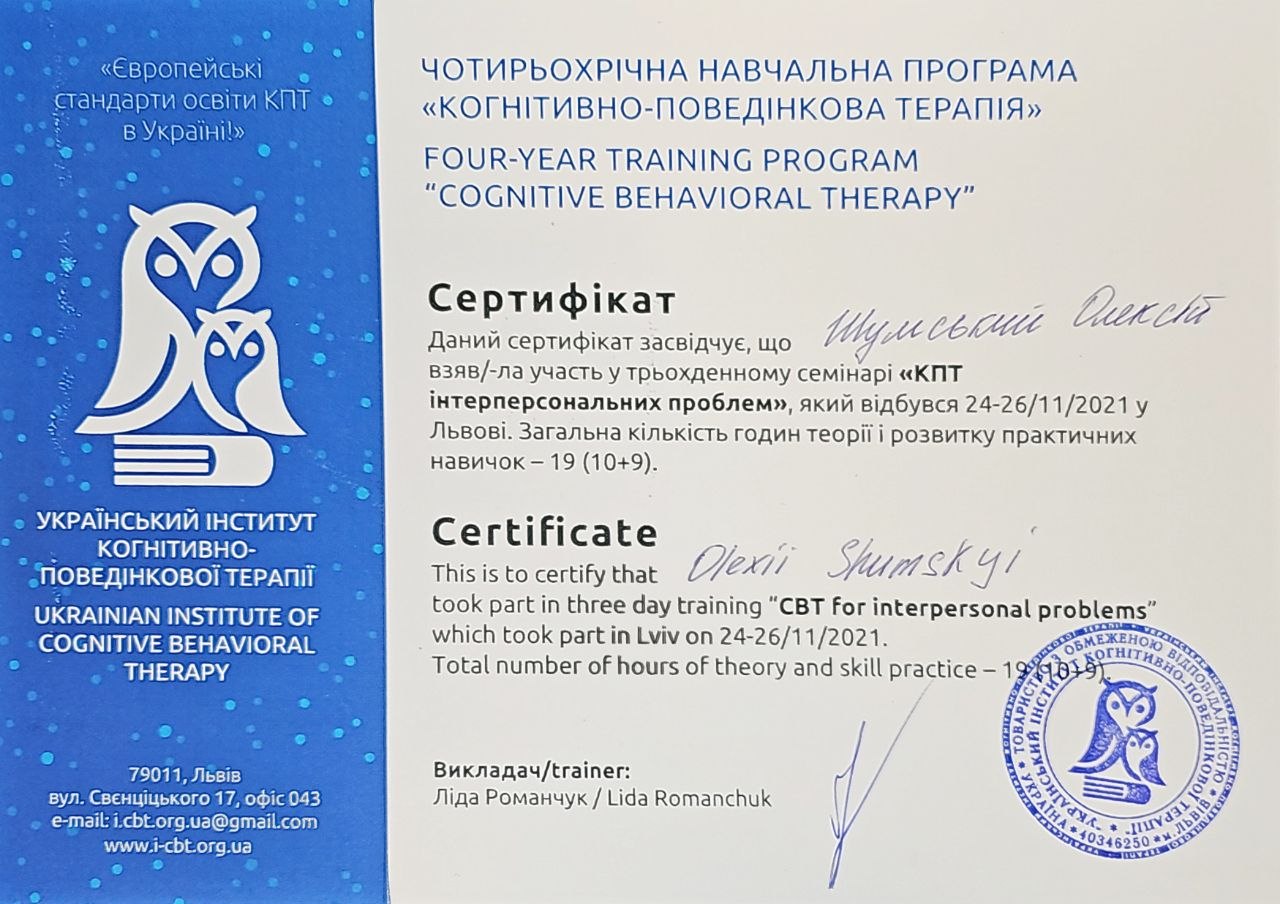
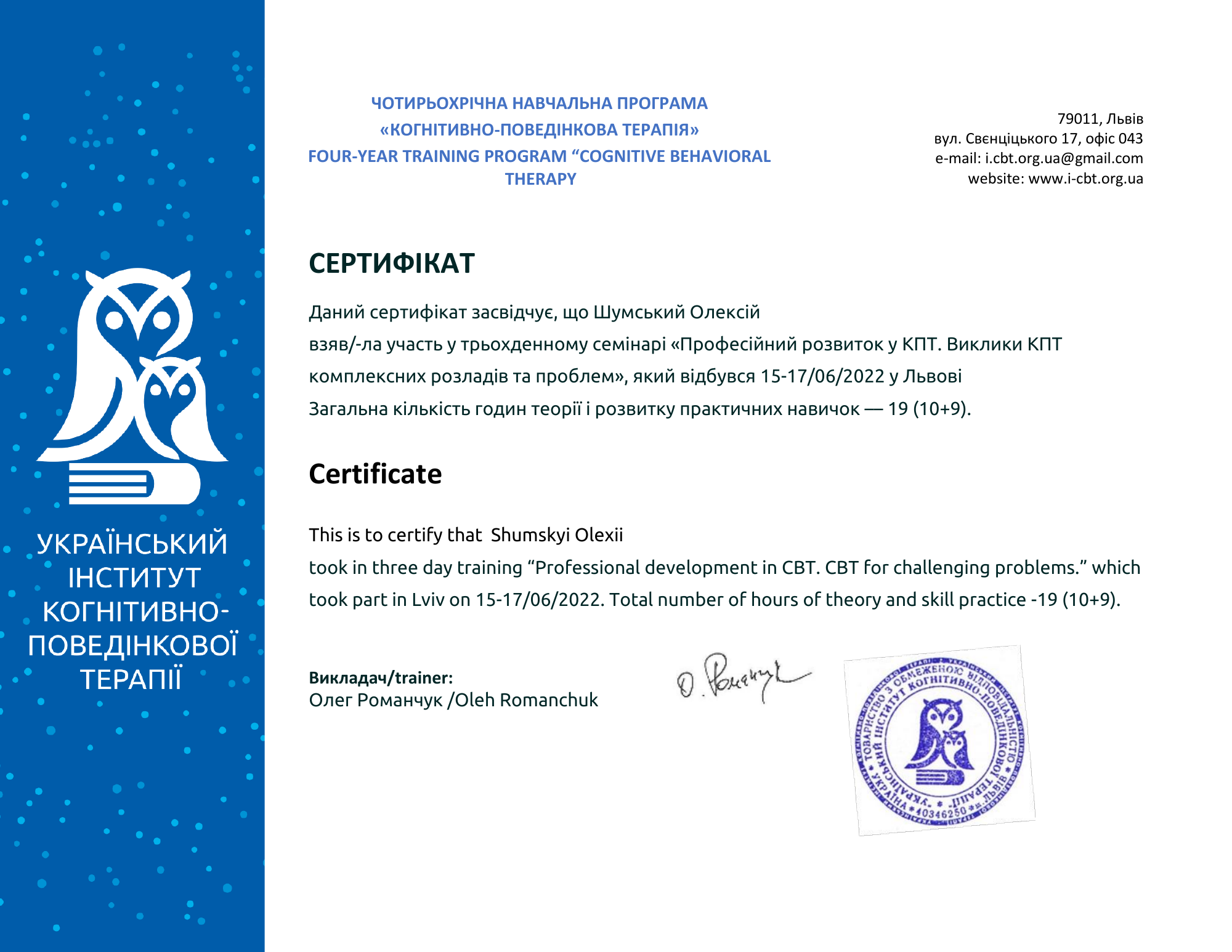
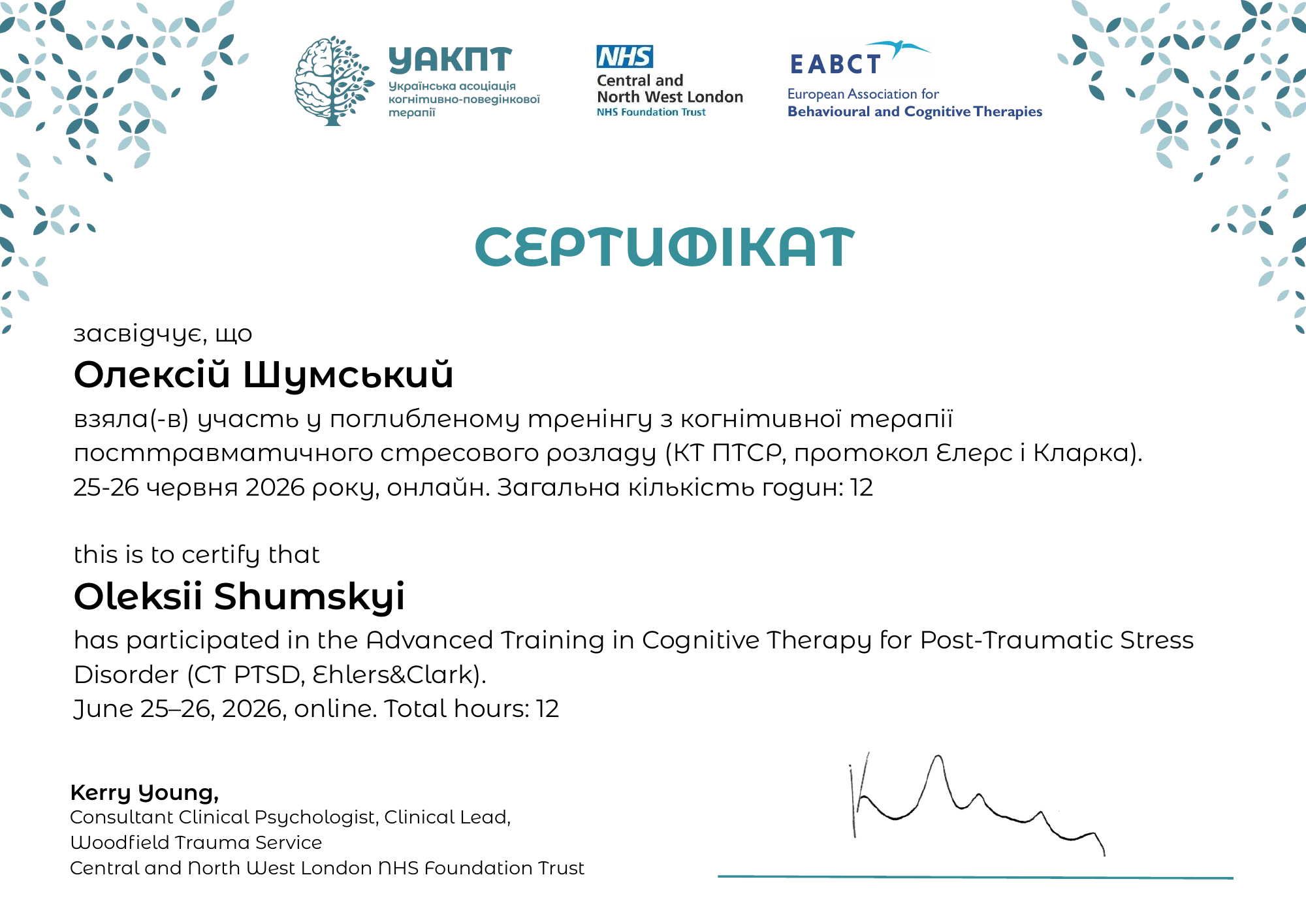
I earned my bachelor’s degree in psychology at National Pedagogical Dragomanov University (now Dragomanov Ukrainian State University). At the Ukrainian Institute of Cognitive Behavioral Therapy, I completed four years of psychotherapy training in CBT. I’m currently studying for a master’s in political psychology at Taras Shevchenko National University of Kyiv. I also trained in schema therapy, group psychotherapy, and working with ADHD, and completed many year-long and short courses and seminars. I study continuously and work under ongoing supervision. I’m a member of the Ukrainian Association for Cognitive and Behavioral Therapy. I’ve been in psychotherapy myself: psychoanalysis, Gestalt therapy, CBT, and schema therapy.




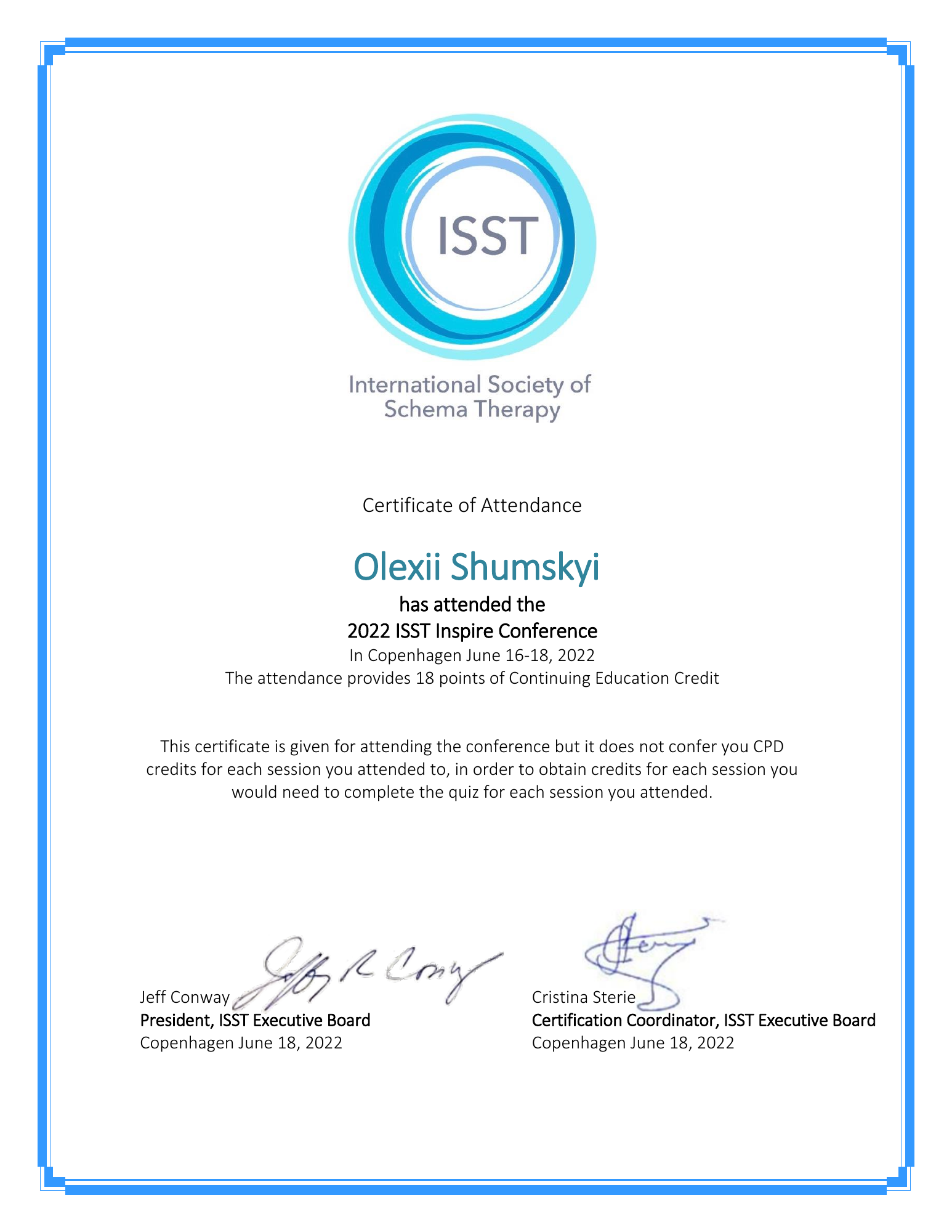
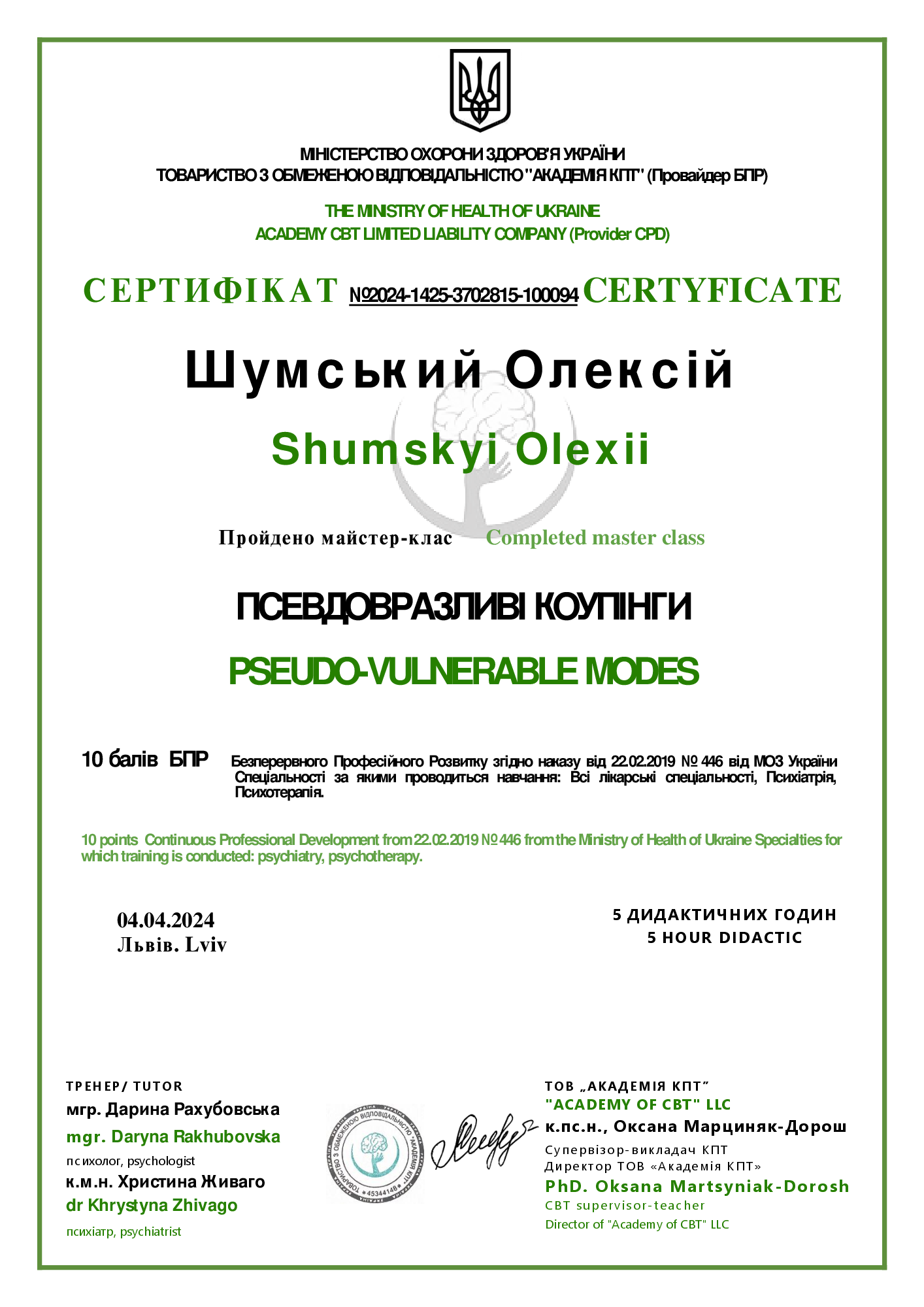

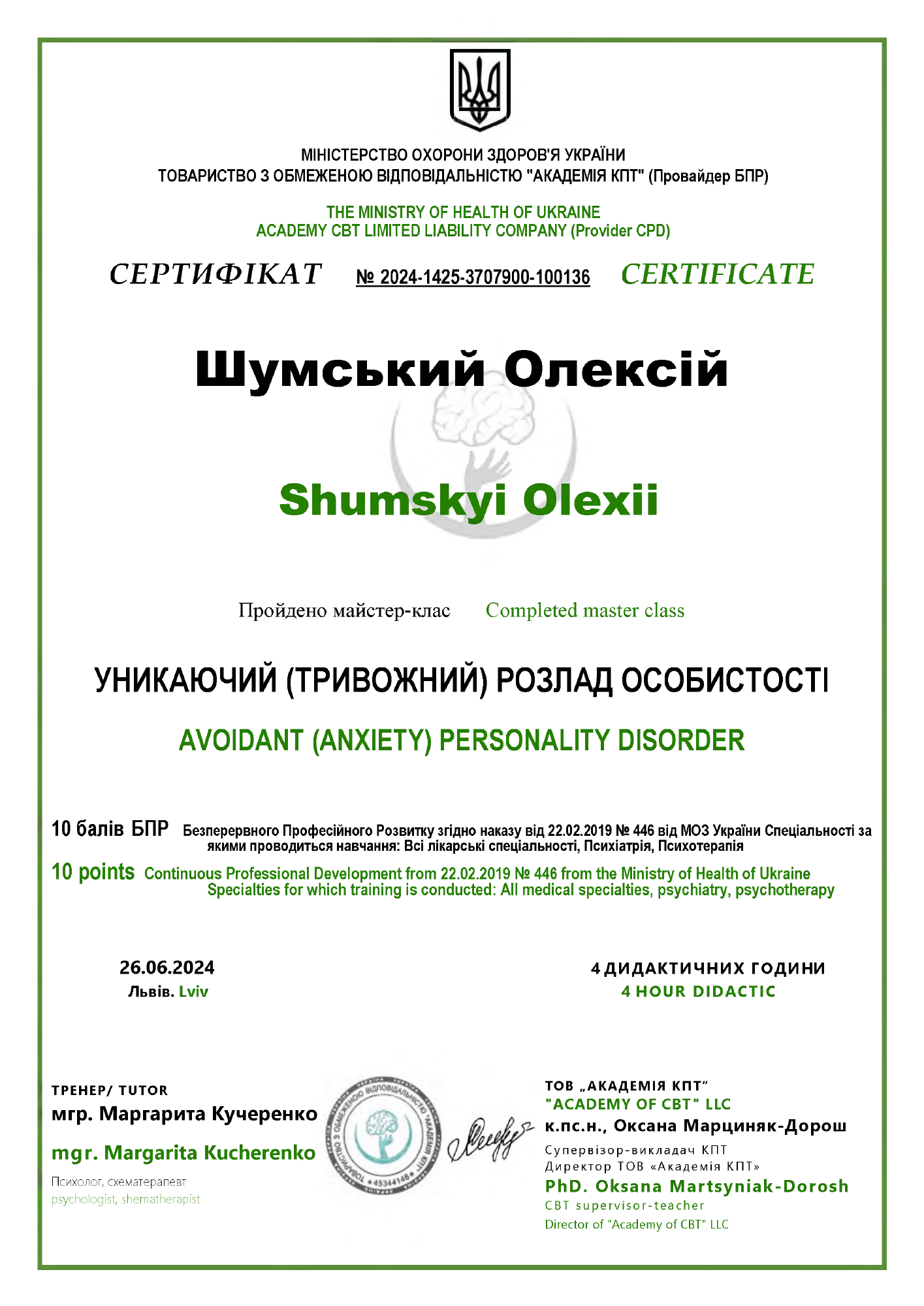
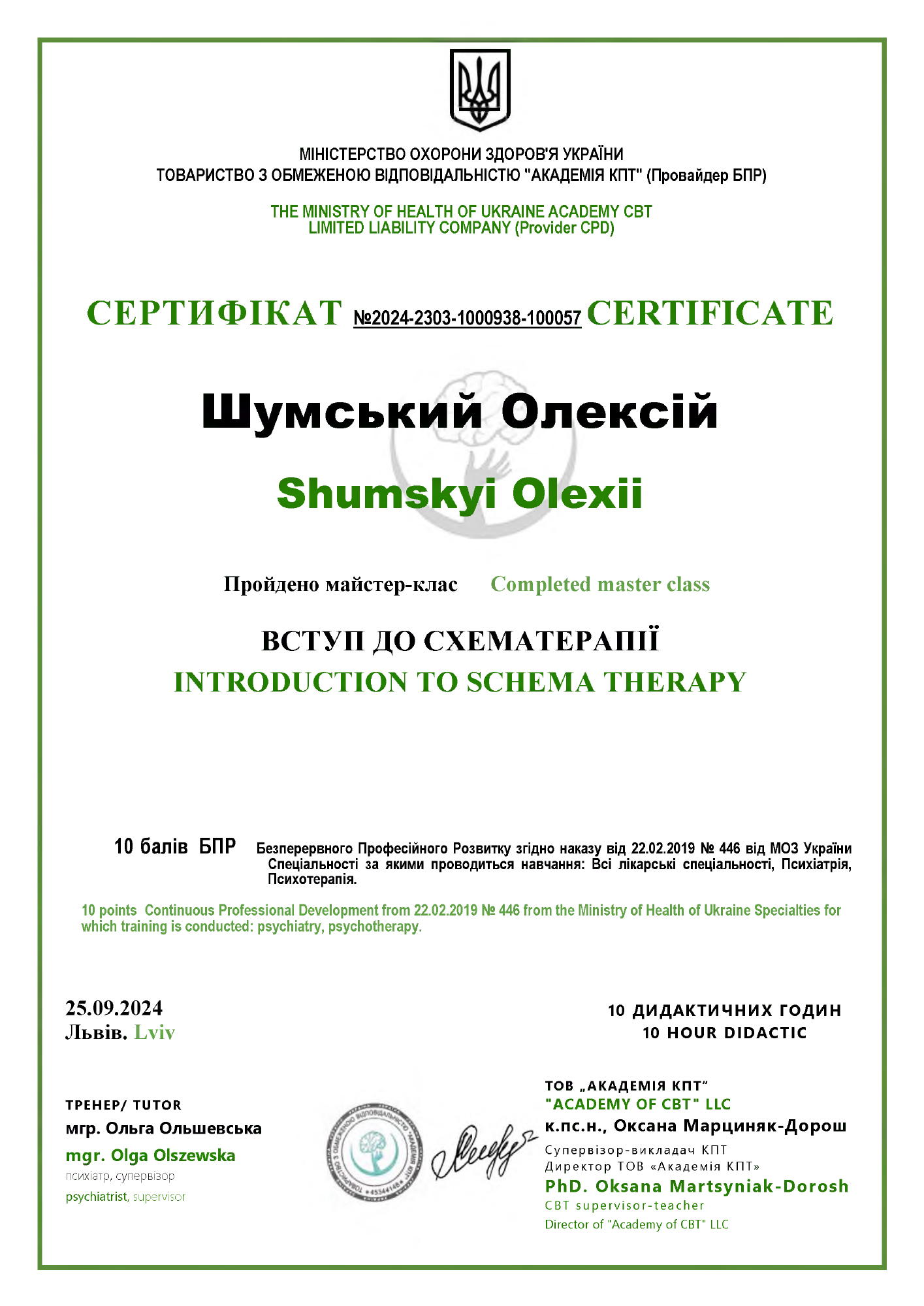

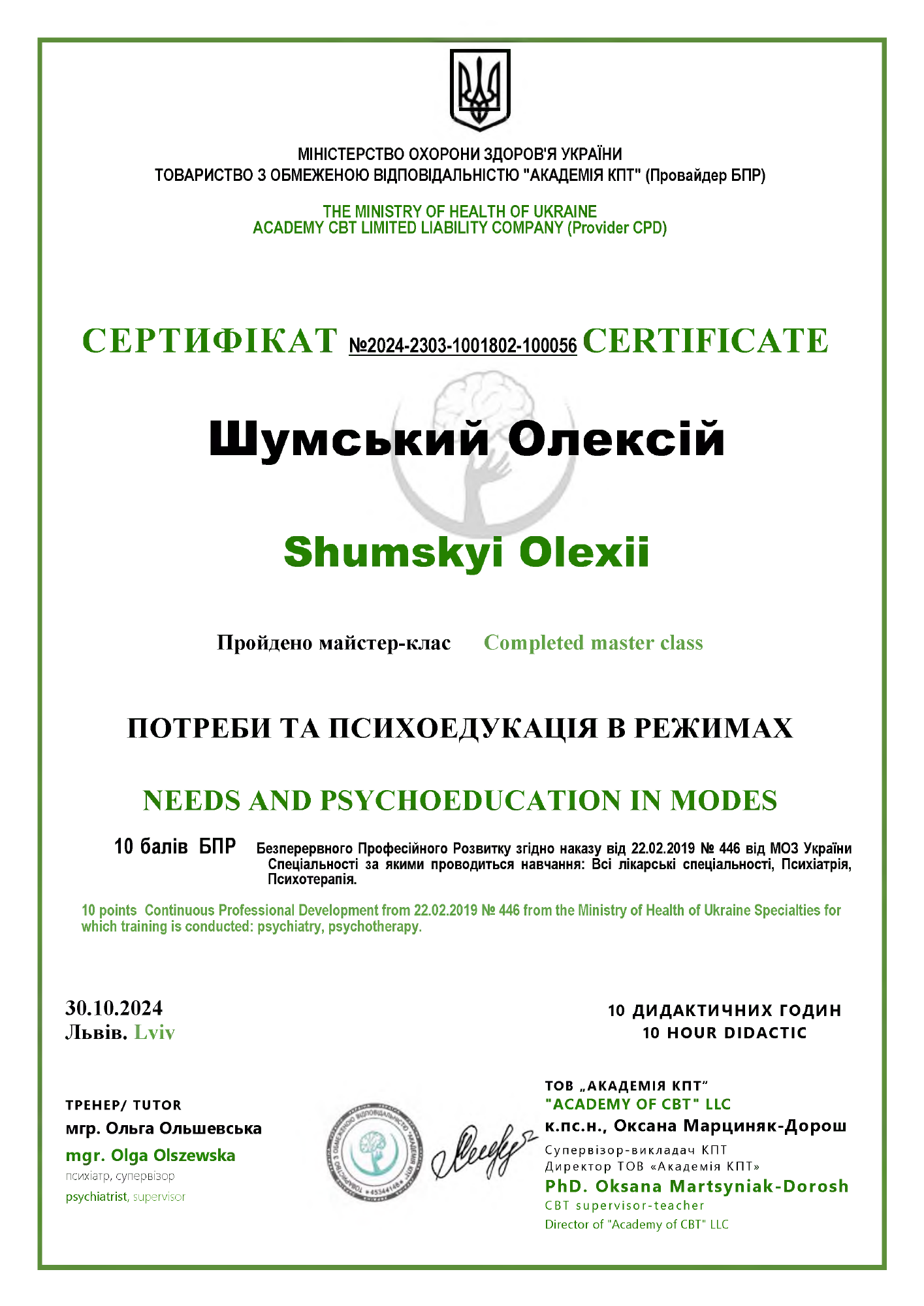
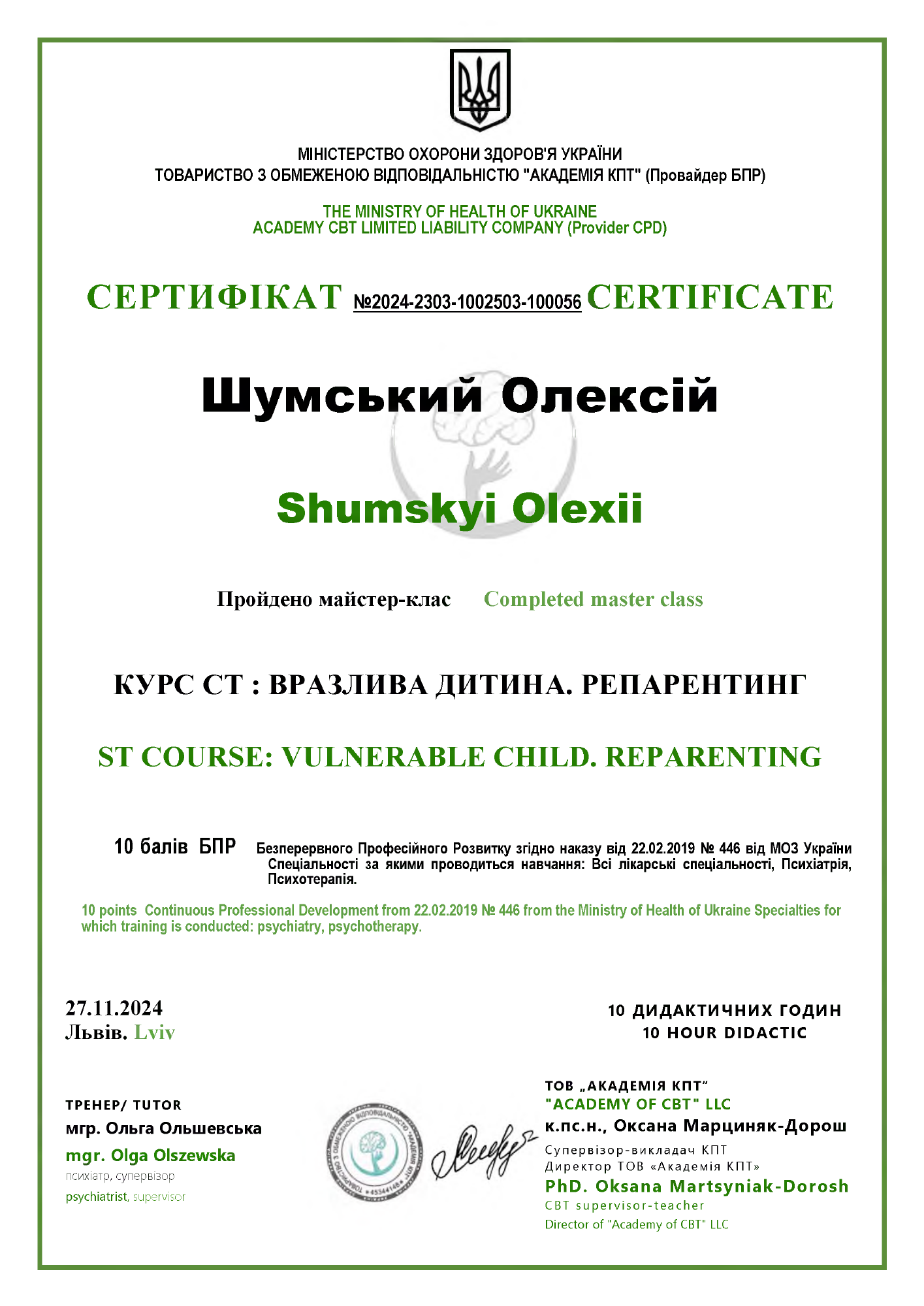

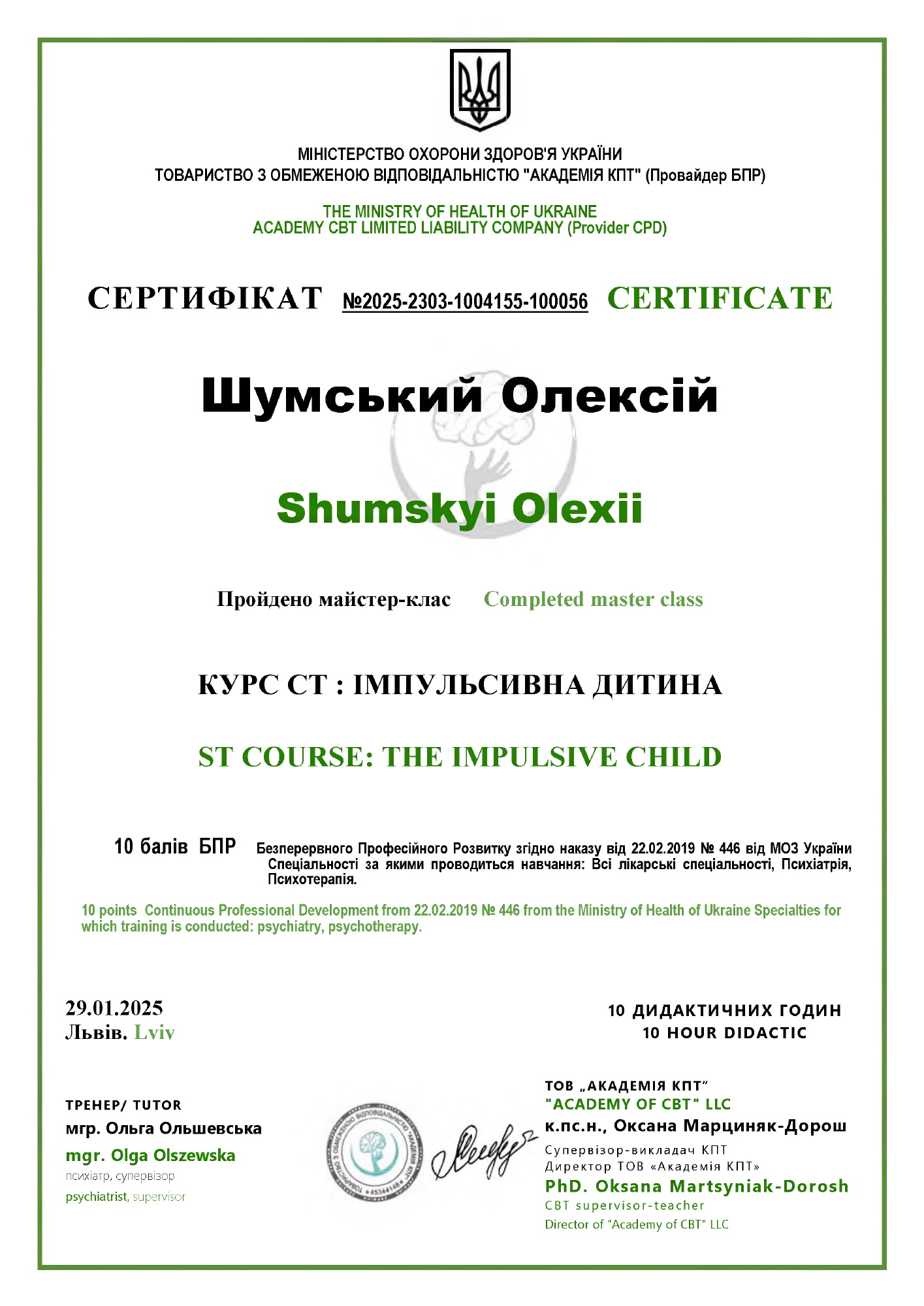

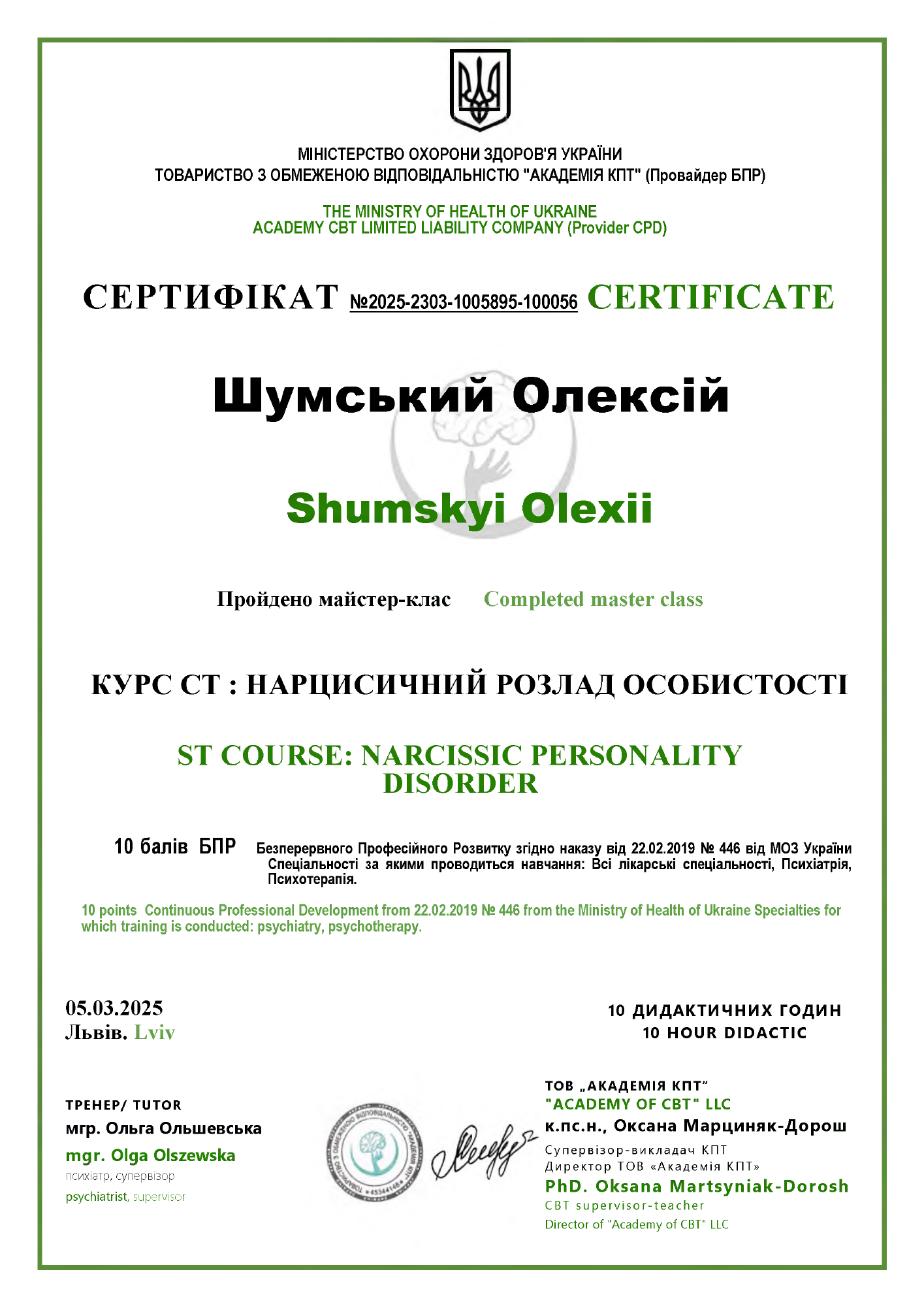
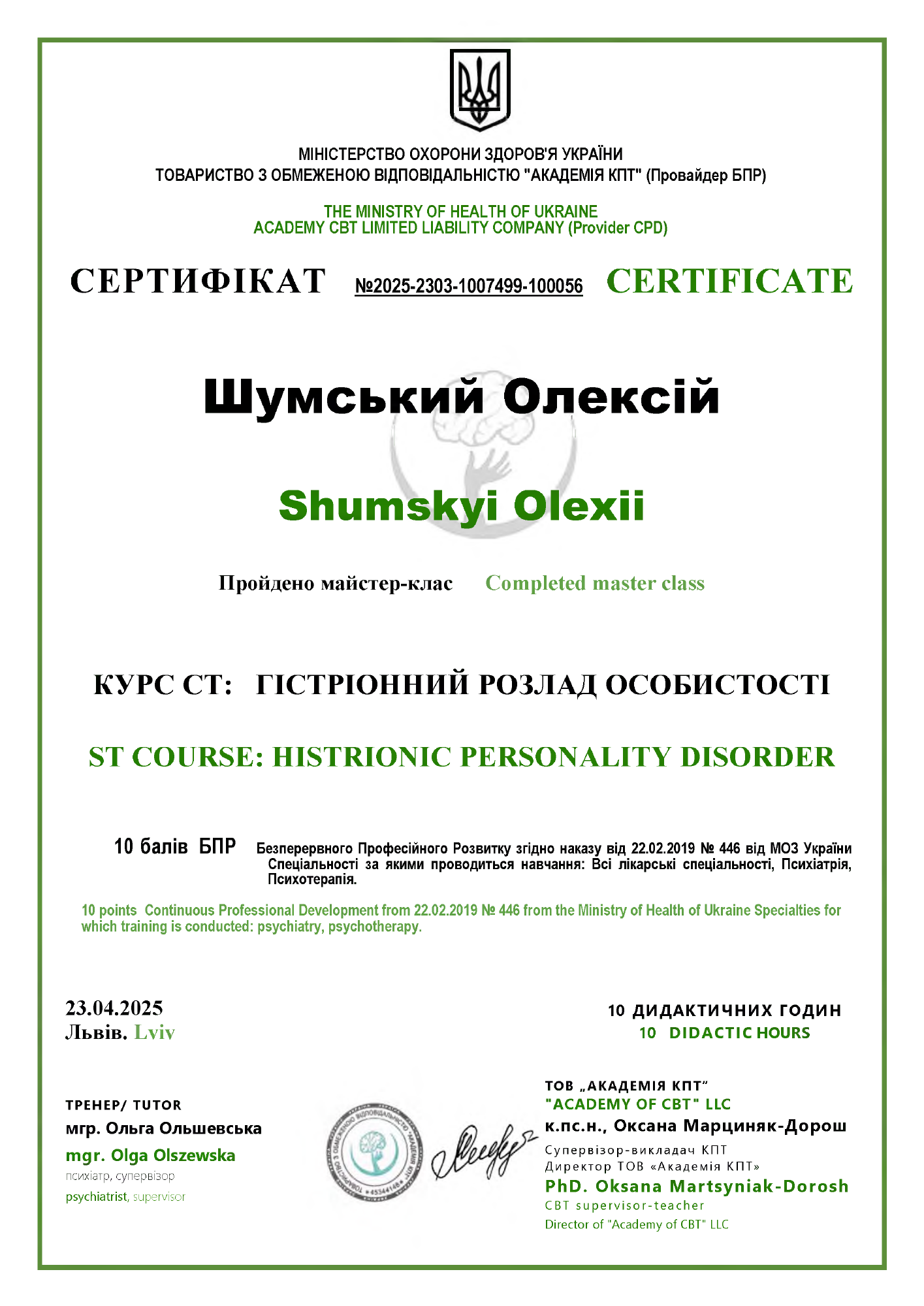
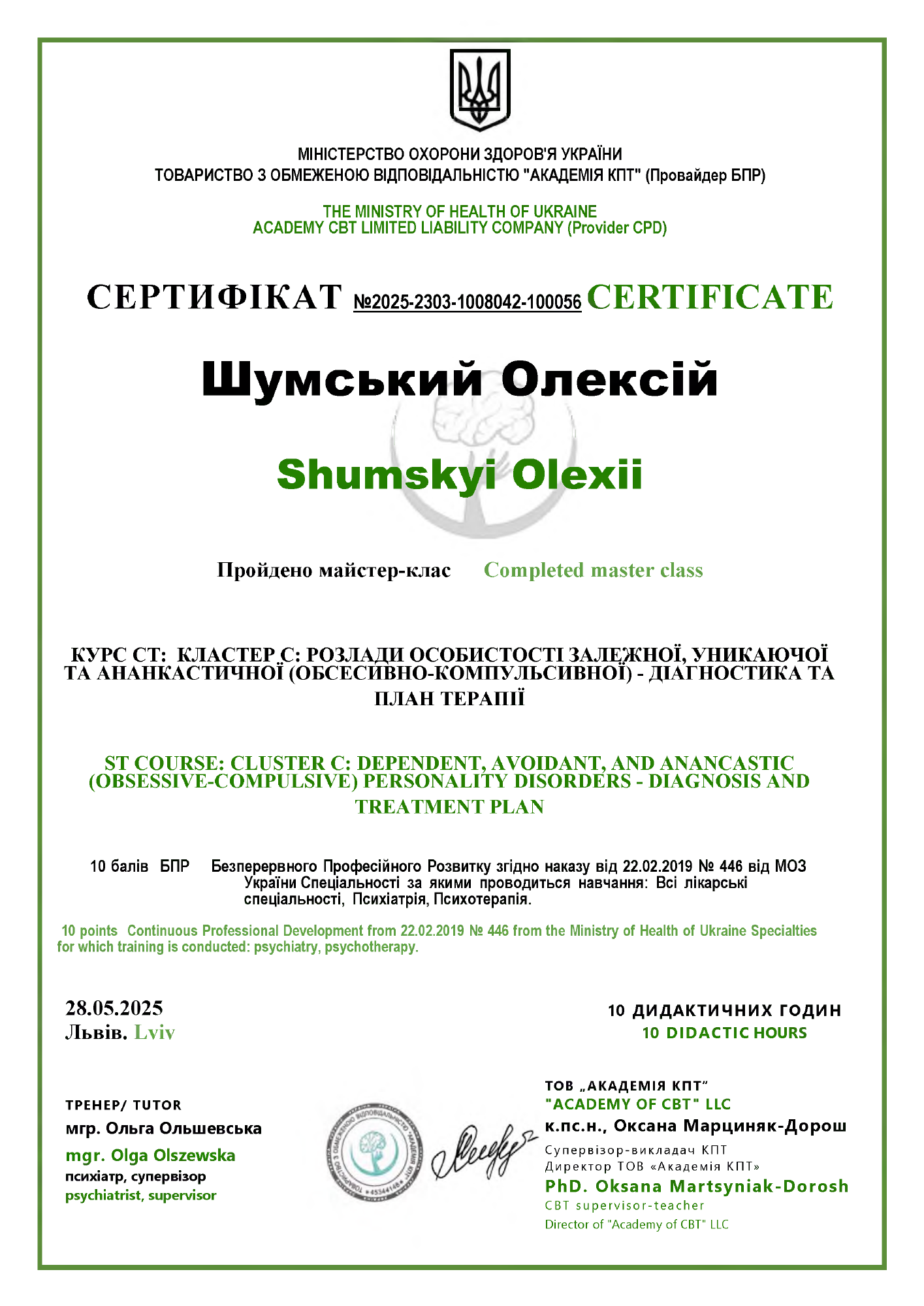
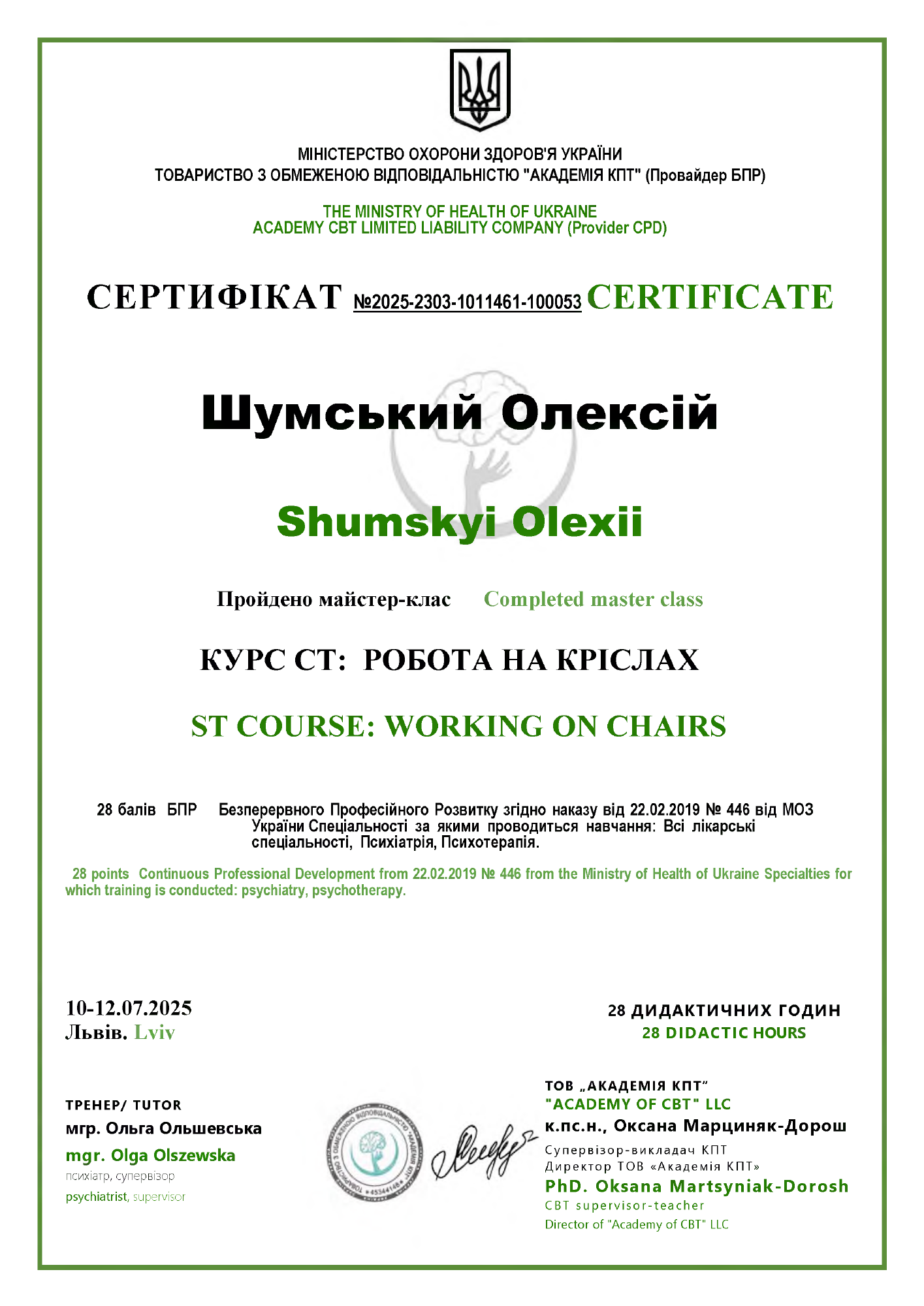
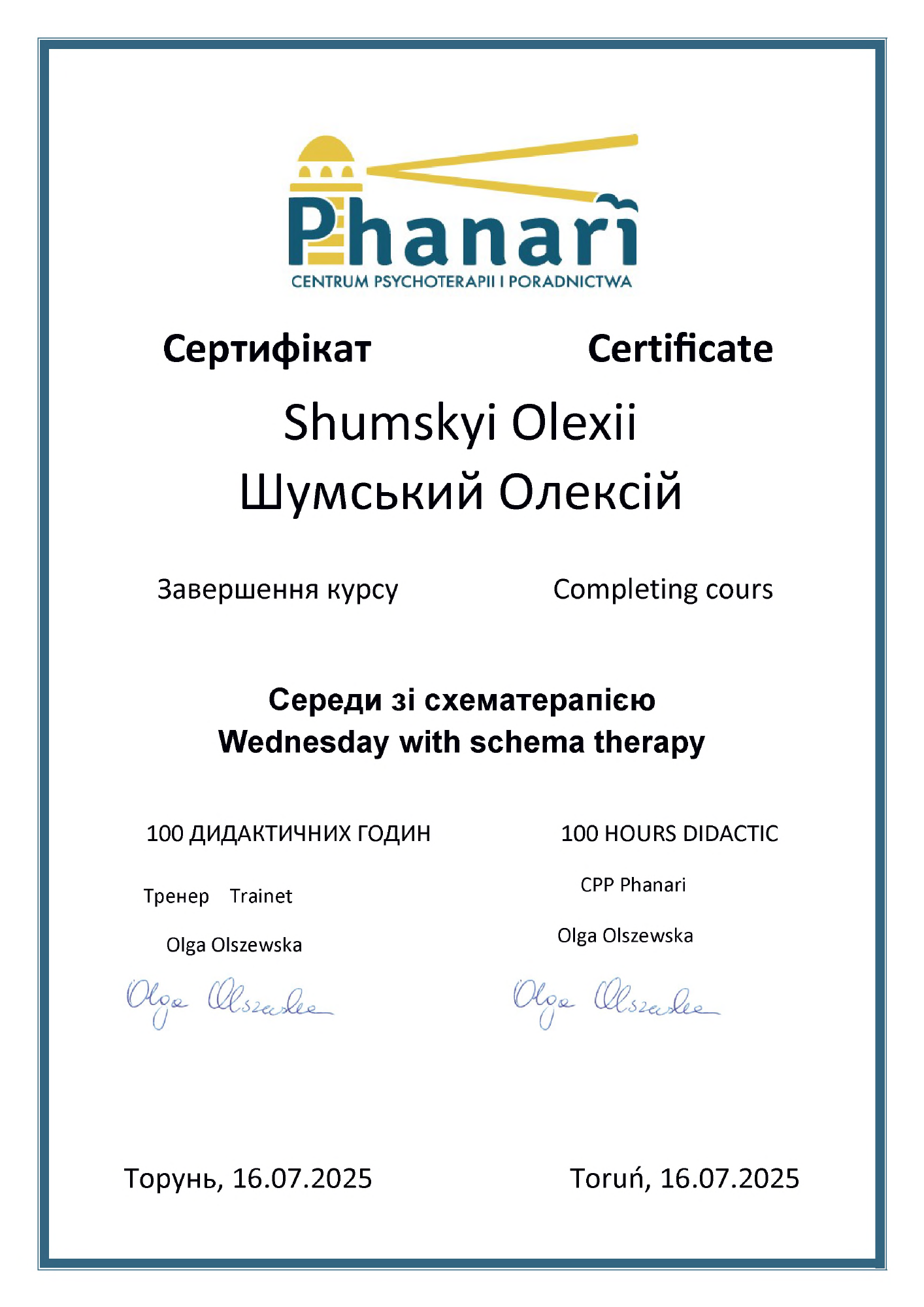
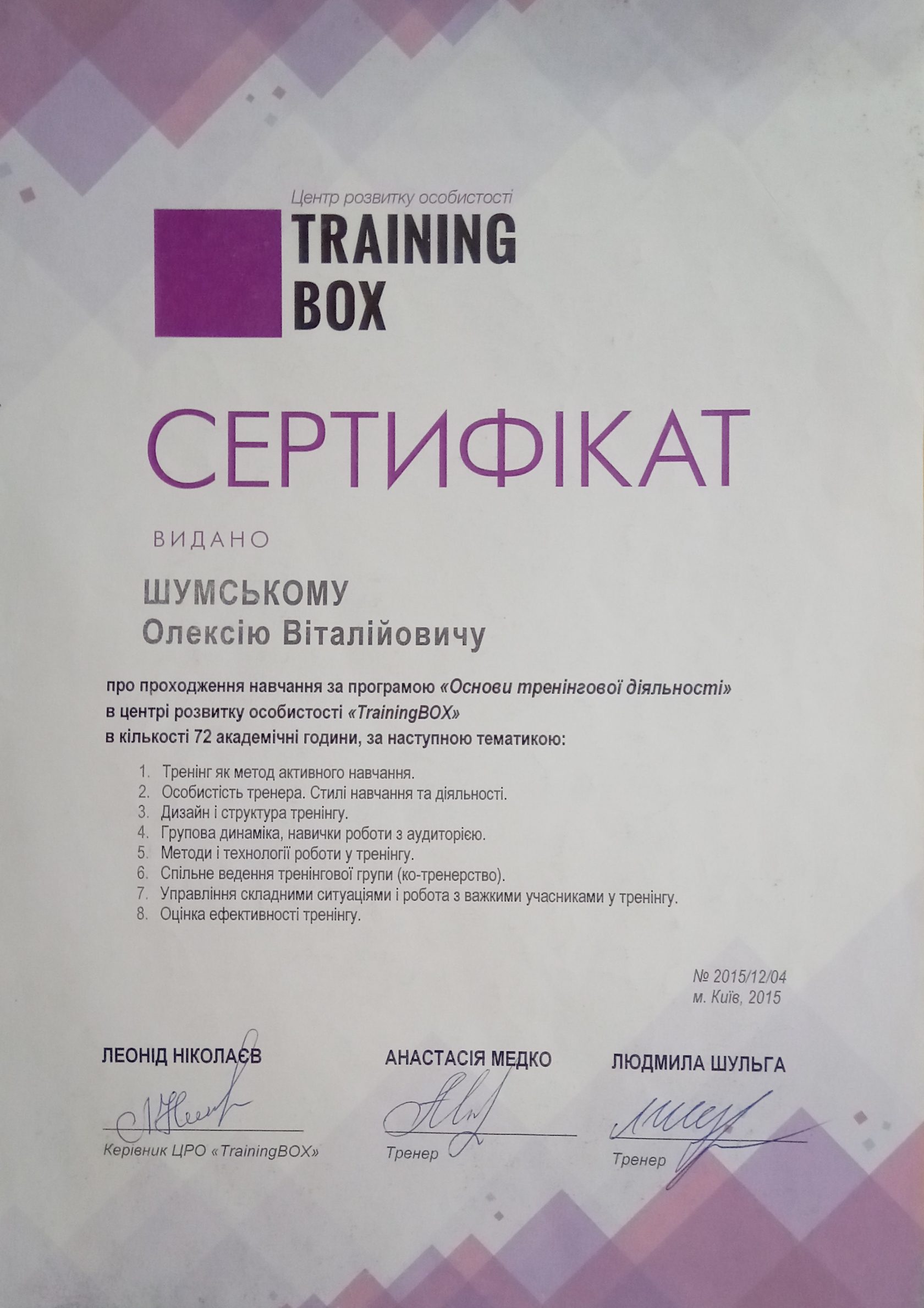
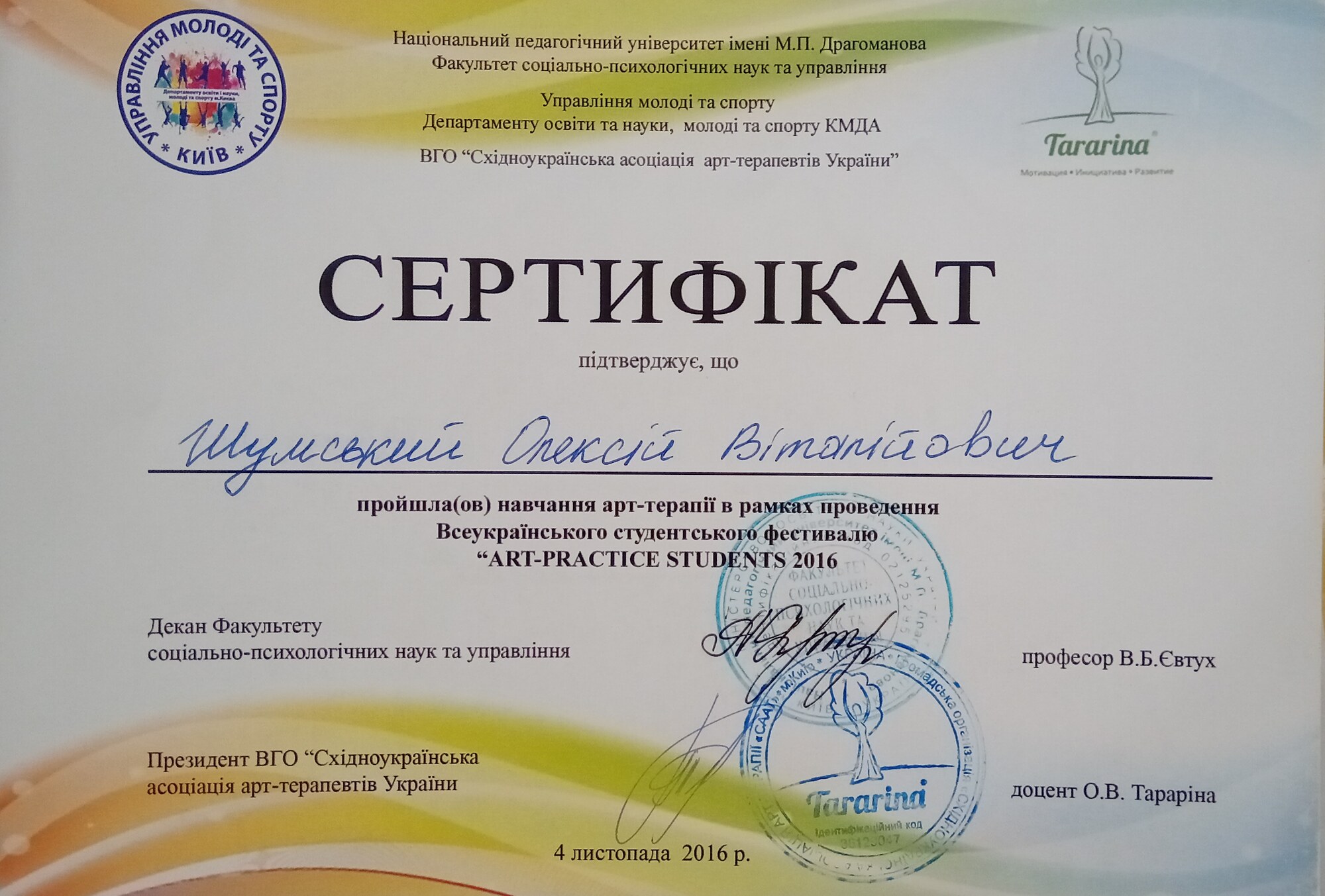


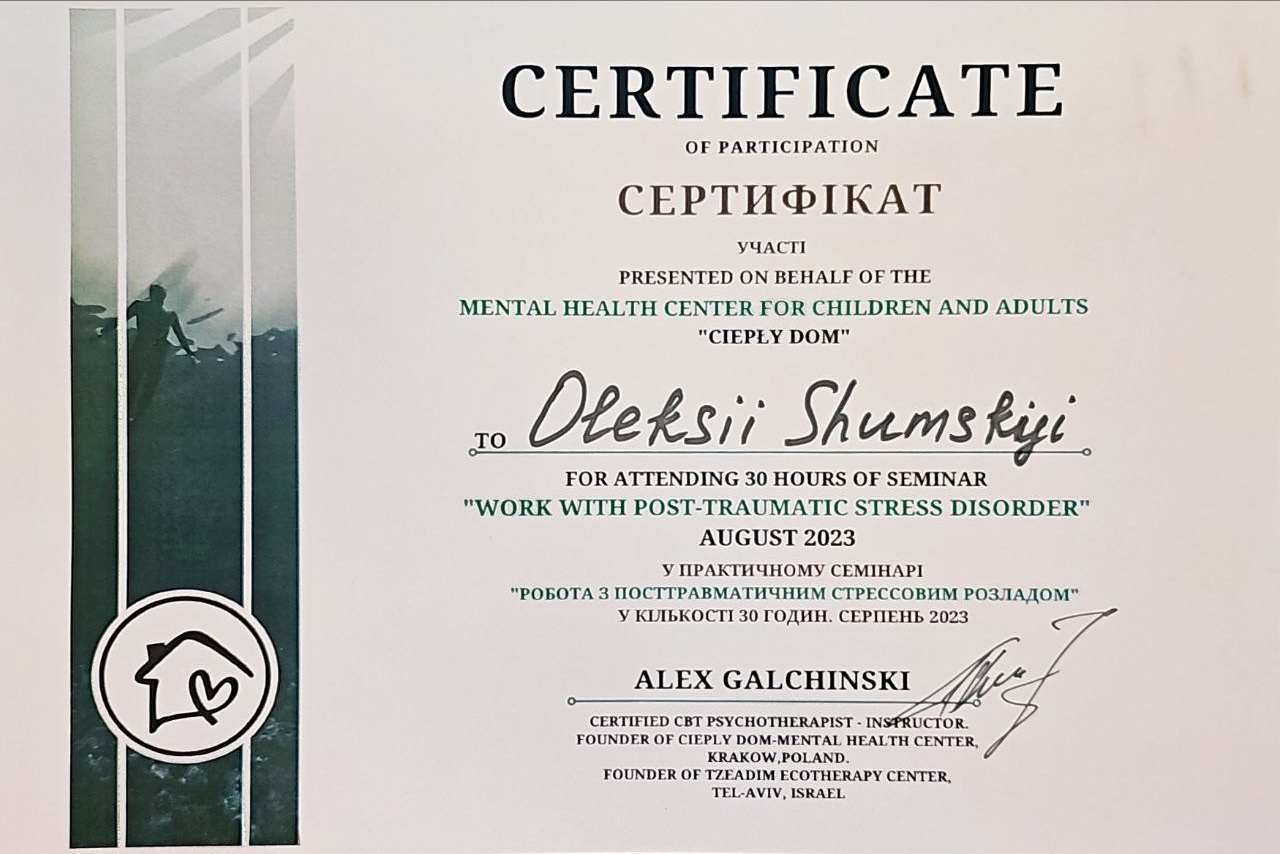



Organizations I’ve worked with





Format and booking
Sessions take place online, on Google Meet. Each one is scheduled for 55 minutes and sometimes runs longer, so it’s best to set aside an hour and a half for it: that leaves time to catch your breath.
A session costs UAH 1,800. Payment is in full, at the time of booking, by card from a bank in Ukraine or another country. Your booking is confirmed after payment.
No one can say exactly in advance how long therapy will take. A lot depends on what kind of psychotherapy is needed:
- Problem-focused — when there’s a specific issue, for example, how to learn to say “no” to your boss. The work concentrates on that issue, so it’s usually shorter.
- Supportive — when sessions are needed from time to time. Sometimes people move to it after the main work. By then the person mostly copes on their own, and occasional sessions help them hold on to what they’ve gained amid day-to-day life and notice in time if the old loop starts coming back. And sometimes hard circumstances go on for a long time and are out of the person’s control. Then sessions make it possible to stop, take a good look at what’s happening, and choose how to live in those circumstances.
- Personality-focused — when you want to change ingrained ways of thinking and acting. They’re usually long-standing and recur in different areas: in relationships, at work, in how you relate to yourself. Taking apart one reaction isn’t enough here: we figure out how these ways took shape, what job they once did, and what they still protect. That’s why it goes deeper and takes longer.
These aren’t three separate therapies to pick from once and for all. All three can be parts of one process. The same person who’s learning to say “no” to their boss may notice that saying no is hard for them at home and with friends, too. Then, if they want, we move on to personality-focused work. Once the main work is done, sessions can become supportive and less frequent. And if a new specific issue comes up, we focus on it again. Some people need one of them, and some need all three.
After the first few sessions, it’s already possible to make a careful guess about how long it will take.
Available times are shown on the booking page. If you have questions, write to me on Telegram or by email. I don’t answer calls, so it’s better to write.
- Telegram: @olexiishumskyi
- Email: olexiishumskyi@gmail.com